 United States
Rechargeable vs. Non-Rechargeable Disposables: What’s the Difference?
This content is intended for adult vapers of legal purchasing age. Disposable vape specifications, battery capacity, charging requirements, and expected lifespan vary by device. Always follow the manufacturer's instructions for use and charging.
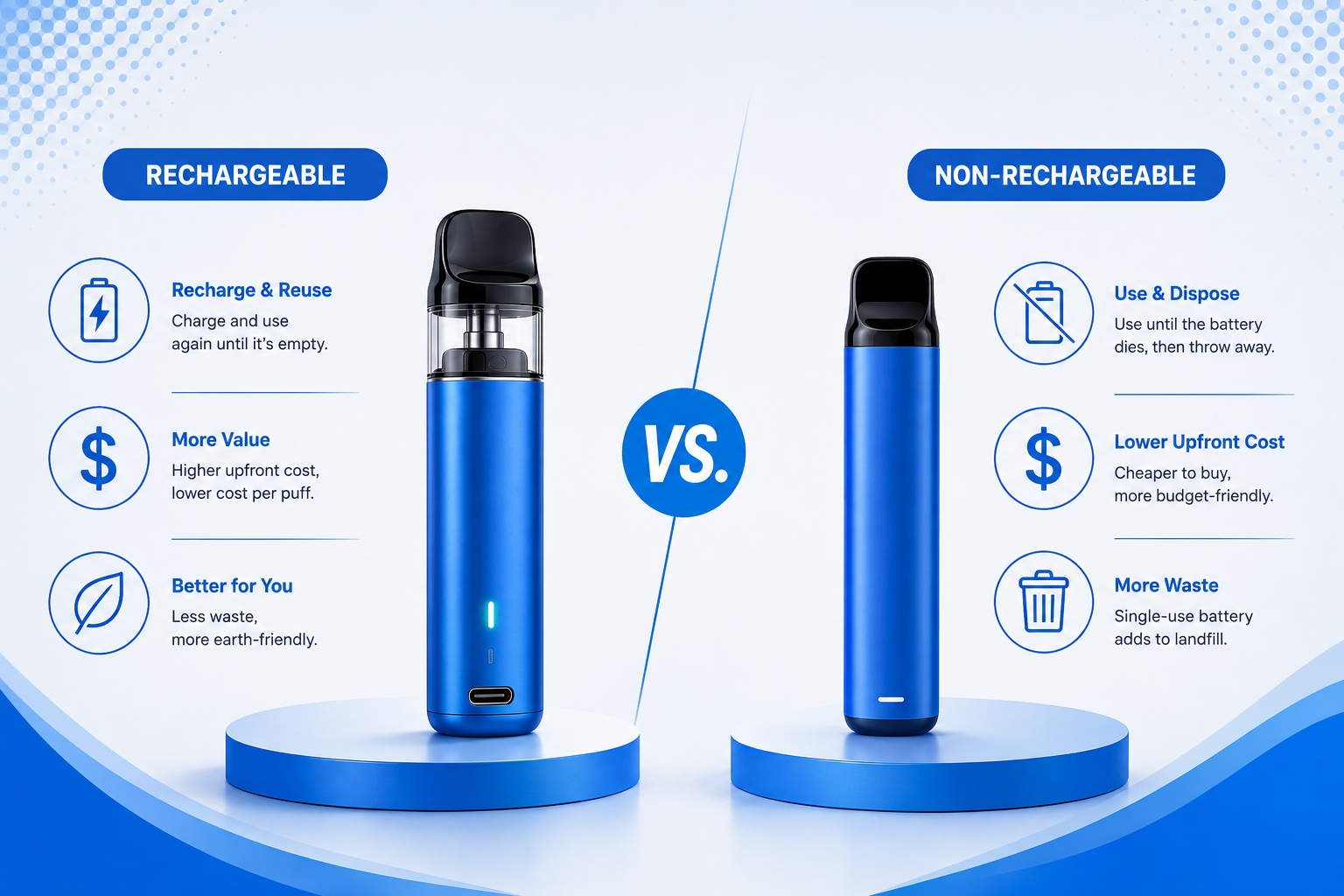
Rechargeable and non-rechargeable disposables may look similar, but the main difference is how the battery supports the e-liquid capacity of the device. Rechargeability becomes especially relevant when a disposable contains more e-liquid than a practical single battery charge can support.
For larger-capacity disposable vapes, being able to recharge can help the battery continue supporting the device while usable e-liquid remains. Smaller devices may be designed around a single battery charge instead.
Here's what separates the two designs and when rechargeability actually matters.
Rechargeable vs. Non-Rechargeable: What's the Difference?
A non-rechargeable disposable operates from its initial battery charge. Once the battery is depleted, the device cannot simply be recharged and used again.
A rechargeable disposable allows the internal battery to be charged again, potentially supporting continued use while usable e-liquid remains and the coil is still functioning properly.
Rechargeable doesn't mean refillable. In most cases, you're only recharging the battery — the internal e-liquid supply remains fixed.
| Feature | Rechargeable Disposable | Non-Rechargeable Disposable |
|---|---|---|
| Battery | Can be recharged | Single charge |
| E-Liquid | Fixed | Fixed |
| Charging | Required when battery becomes low | Not supported |
| Typical Capacity | Often moderate to high | Often lower |
| Battery Cycles | Can support multiple charging cycles | Limited to initial charge |
| Convenience | Requires occasional charging | No charging required |
Why Rechargeability Matters More on Bigger Disposables
The more e-liquid a disposable holds, the more battery power the device may need over its usable lifespan.
With a non-rechargeable device, the battery has to support the device without another charge. The North Disposable, for example, illustrates the simpler non-rechargeable approach. Non-rechargeable doesn't automatically mean impractical — what matters is how the battery and device capacity are matched.
Rechargeable devices take a different approach. The Vapengin Disposable uses a rechargeable battery, allowing the battery to be charged again when needed rather than depending entirely on its initial charge.
Quick rule: Don't judge a disposable by the charging port alone. Consider whether its battery design makes sense for the capacity and expected use of the device.
Does Rechargeable Mean More Puffs?
Not automatically. A charging port doesn't increase the amount of e-liquid inside the device, and it doesn't guarantee that every user will reach the advertised puff count.
Real-world disposable lifespan can be affected by e-liquid capacity, draw length, usage frequency, coil resistance, power output, operating mode, airflow, and battery performance.
Rechargeability mainly helps prevent a depleted battery from becoming the reason the device stops functioning while usable e-liquid remains. Advertised puff count is better treated as an estimate rather than an exact number every user will achieve.
Where Rechargeable Disposables Have the Advantage
Better Use of the Available E-Liquid
If the battery becomes low while usable e-liquid remains, a rechargeable device can be charged again rather than becoming unusable solely because its battery is depleted. This can be particularly relevant to higher-capacity disposables.
More Practical for Extended Use
A device designed to remain in use for a longer period may need more than one battery cycle. Rechargeability allows the battery to support that extended operating period, although it adds the need for occasional charging.
Low Battery Doesn't Always Mean the Device Is Finished
Weak or reduced output can sometimes occur when battery power is low. If low battery is the cause, charging may restore normal operation. Charging won't fix a depleted e-liquid supply, damaged hardware, or a coil that has reached the end of its usable life.
Where Non-Rechargeable Disposables Still Make Sense
Simpler Operation
Non-rechargeable disposables don't require charging cables or charging time. The device operates from its initial battery charge and is replaced when it reaches the end of its usable life.
No Charging Routine
For someone prioritizing minimal maintenance, not having to monitor battery level or recharge the device can be convenient.
One Charge May Be Enough
A non-rechargeable design isn't automatically inefficient. If the battery is appropriately matched to the device's usable capacity and operating requirements, rechargeability may not be necessary for the intended lifespan of the product.
What to Compare Between the Two Designs
E-liquid capacity: Consider how much e-liquid the device is designed to hold.
Battery capacity: Check whether the battery specification makes sense for the size and operating requirements of the device.
Rechargeability: Consider whether the device is expected to need more than one battery cycle.
Coil design: Different coil configurations and resistance levels can affect power requirements and e-liquid consumption.
Power modes: Devices with adjustable or higher-output operating modes may use battery power differently.
Advertised puff count: Treat the manufacturer's puff estimate as a specification rather than a guaranteed individual result.
Charging instructions: Rechargeable devices should be charged and handled according to the manufacturer's instructions.
Charging and Battery Safety Matter
Rechargeability adds another consideration: proper battery handling. Charging requirements can vary between devices, so the manufacturer's instructions should determine how a specific disposable is charged and handled.
The U.S. Food and Drug Administration advises users to understand and follow the manufacturer's recommendations for the use and care of vaping devices and their batteries. Charging should also be done on a clean, flat surface away from materials that can easily catch fire.
If a rechargeable disposable becomes unusually hot, appears damaged, or shows other abnormal battery behavior, stop using or charging it and follow the manufacturer's guidance.
So, What's the Practical Difference?
Rechargeable disposables are designed to let the battery support more than one charge cycle when necessary. This can be useful in devices intended to remain operational beyond what a single battery charge can reasonably support.
Non-rechargeable disposables prioritize simplicity. They rely on the initial battery charge being appropriately matched to the intended usable life of the device.
Neither design is automatically more practical for every user. The important distinction is whether the device's battery design, e-liquid capacity, and expected operating period work together appropriately.
Bottom Line
Rechargeable and non-rechargeable disposables primarily differ in how their batteries support the usable life of the device.
Rechargeable designs allow additional battery cycles when needed, which can be particularly useful for higher-capacity devices. Non-rechargeable designs rely on a single charge and can remain practical when battery capacity is appropriately matched to the device.
Instead of focusing only on whether a disposable has a charging port, compare battery design, e-liquid capacity, charging requirements, and expected usable lifespan.
Sources & Further Reading
- U.S. FDA — Tips to Help Avoid Vape Battery Fires or Explosions
- U.S. FDA — Electrical Safety in CTP-Regulated Products
Disposable vape specifications, battery capacity, charging requirements, and availability vary by manufacturer, product, country, and region. Always follow the manufacturer's instructions and applicable local regulations.