 United States
Rechargeable vs. Non-Rechargeable Disposables: Is the Extra Cost Worth It
This content is intended for adult vapers of legal purchasing age. Disposable vape specifications, battery capacity, and expected lifespan vary by device, so always follow the manufacturer's instructions.
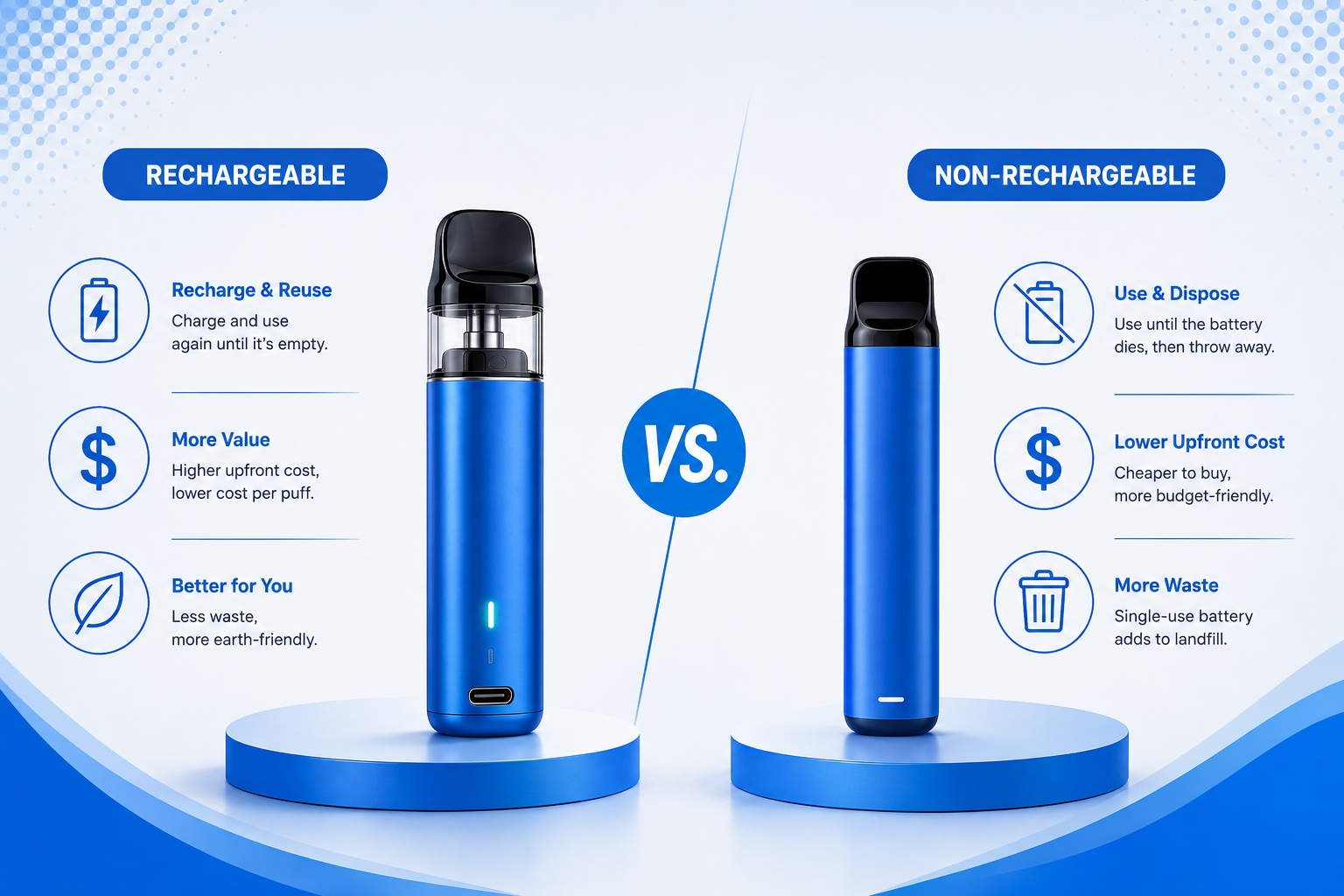
Rechargeable disposables usually cost more than basic non-rechargeable options, but the charging port itself isn't really the advantage. What matters is whether the battery can keep up with the amount of e-liquid inside the device.
For larger-capacity disposable vapes, being able to recharge can help you use more of the available e-liquid. For smaller devices or occasional use, paying extra for that feature may not make much difference.
Here's what actually separates the two.
Rechargeable vs. Non-Rechargeable: What's the Difference?
A non-rechargeable disposable runs on one battery charge. Once that battery is depleted, the device is finished, regardless of whether any usable e-liquid remains.
A rechargeable disposable lets you recharge the internal battery and continue using the device until the e-liquid is depleted or the coil reaches the end of its usable life.
Rechargeable doesn't mean refillable. In most cases, you're only recharging the battery — the internal e-liquid supply stays fixed.
| Feature | Rechargeable Disposable | Non-Rechargeable Disposable |
|---|---|---|
| Battery | Can be recharged | Single charge |
| E-Liquid | Fixed | Fixed |
| Upfront Cost | Usually higher | Often lower |
| Typical Capacity | Moderate to high | Often lower |
| Charging Required | Yes | No |
| Convenience | Requires occasional charging | Use and replace |
| Best Fit | Regular or extended use | Simple or occasional use |
Why Rechargeability Matters More on Bigger Disposables
The more e-liquid a disposable holds, the more battery power it needs over its lifetime.
With a non-rechargeable device, the battery has to be sized to support the usable e-liquid without another charge. The North Disposable, for example, follows this simpler approach without requiring the battery to be recharged during use. It's a useful example of why non-rechargeable doesn't automatically mean impractical — what matters is how well the battery and e-liquid capacity are matched.
Rechargeable devices take a different approach. The Vapengin Disposable uses a rechargeable battery, allowing the device to be topped up when its battery gets low instead of depending entirely on a single charge.
Quick rule: Don't judge a disposable by the charging port alone. Look at whether its battery setup makes sense for the amount of e-liquid the device is designed to use.
Does Rechargeable Mean More Puffs?
Not automatically. A charging port doesn't increase the amount of e-liquid inside the device, and it doesn't guarantee you'll reach the advertised puff count.
Real-world disposable lifespan depends on several things:
- E-liquid capacity
- Draw length
- How frequently you vape
- Coil resistance
- Power output
- Operating mode
- Airflow
- Battery efficiency
Rechargeability mainly reduces the chance that a depleted battery becomes the reason you stop using the device while usable e-liquid remains. Advertised puff count is better treated as an estimate rather than an exact number every user will achieve.
Where Rechargeable Disposables Have the Advantage
Better Use of the Available E-Liquid
If the battery gets low before the e-liquid is depleted, you can recharge instead of replacing the entire device. For larger disposables, this can make the usable lifespan better match the amount of e-liquid you're paying for.
More Practical for Regular Use
Someone using a disposable throughout the day is more likely to benefit from multiple battery cycles than an occasional user. Charging adds a small amount of maintenance, but it can be a reasonable trade-off when the device is expected to last significantly longer.
Battery Performance Can Be Restored
Weak vapor doesn't always mean the disposable is finished. Sometimes the battery is simply low. If low battery is the cause, recharging can restore normal power output. It won't, however, fix a worn coil or replenish e-liquid.
Where Non-Rechargeable Disposables Still Make Sense
They're Simpler
No cable. No charging time. No battery level to monitor. For someone choosing a disposable specifically because they want as little maintenance as possible, that's a real advantage.
Lower Upfront Cost
Basic non-rechargeable devices are often less expensive. If you're an occasional user or don't need a large e-liquid capacity, paying extra for a rechargeable model may not provide enough additional use to justify the difference.
One Charge Can Be Enough
A non-rechargeable design isn't automatically inefficient. If the manufacturer properly matches battery capacity to e-liquid capacity, the battery can last roughly as long as the usable e-liquid. In that situation, rechargeability isn't necessary.
What About the Extra Cost?
Don't compare the devices based on purchase price alone. A cheaper disposable isn't necessarily better value if the battery stops working while usable e-liquid remains. On the other hand, paying more for a large rechargeable disposable doesn't necessarily make sense if your usage is light enough that you won't benefit from the additional capacity.
A more useful comparison is price → usable e-liquid → realistic lifespan. That gives you a better picture of what you're actually getting for the money than simply comparing which disposable has the lowest purchase price.
What to Compare Before Buying
- E-liquid capacity: How much liquid is actually inside?
- Battery capacity: Is the battery appropriately sized for the device?
- Rechargeability: Is the device expected to need multiple battery cycles?
- Coil design: Higher-output coils may consume both e-liquid and battery faster.
- Power modes: Boost or higher-power modes can increase consumption.
- Advertised puff count: Treat it as an estimate rather than a guaranteed lifespan.
- Price: Compare cost against realistic usable life, not specifications alone.
So, Is Rechargeable Worth It?
Choose rechargeable if: you use disposables regularly, prefer higher-capacity devices, and don't mind occasionally charging to get more use from the available e-liquid.
Choose non-rechargeable if: you vape occasionally, prioritize simplicity, or prefer smaller devices where a single battery charge is reasonably matched to the e-liquid capacity.
Neither design is automatically the better deal. The better choice depends on how much capacity you'll realistically use and whether charging fits the convenience you're looking for.
Bottom Line
Rechargeable disposables make the most sense when the device carries more e-liquid than a practical single-charge battery could reasonably support. In that situation, charging helps prevent battery life from becoming the limiting factor.
Non-rechargeable disposables still make sense when battery and e-liquid capacity are properly matched, particularly for lighter or occasional use.
Instead of paying extra just because a device is rechargeable, compare battery design, e-liquid capacity, realistic lifespan, and price together. That's a much better indication of whether the extra cost is actually worth it.
Disposable vape specifications and availability vary by manufacturer, country, and region. Always follow the manufacturer's instructions and applicable local regulations.