 United States
VG:PG Ratio Guide – Finding the Perfect Balance for Your Vaping Experience
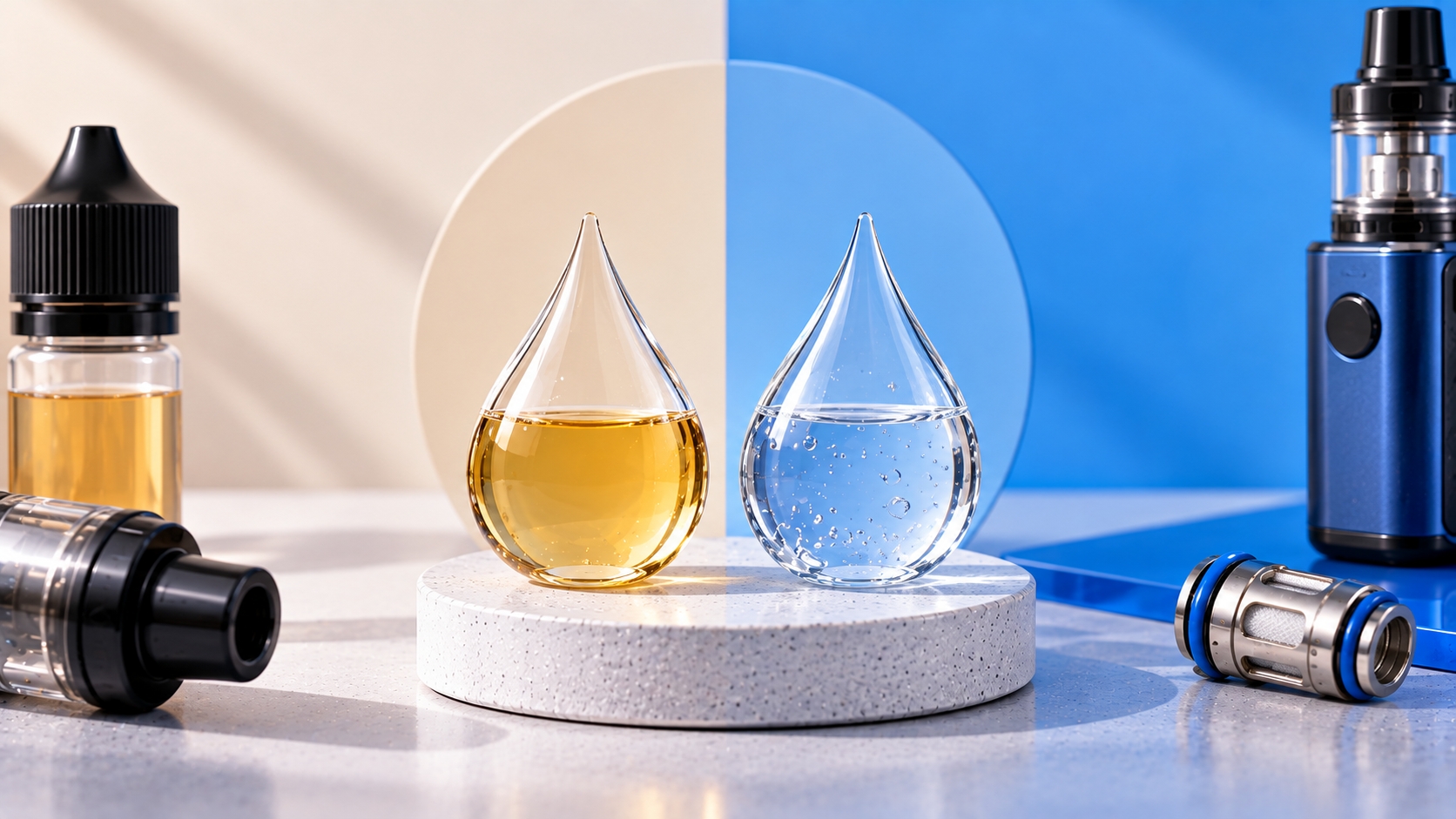
VG:PG ratios affect an e-liquid's viscosity and how it behaves in different vaping setups, but there is no single ratio that fits every pod, tank, or coil. Always check the device or coil manufacturer's recommendations before choosing an e-liquid.
The VG:PG ratio on an e-liquid bottle tells you the relative amounts of vegetable glycerin (VG) and propylene glycol (PG) in the base mixture. Changing that balance affects characteristics such as viscosity, aerosol production, and sensory experience.
But choosing a ratio shouldn't come down to a simple rule like “pods use 50:50” or “sub-ohm tanks use 70:30.” Coil design, wick openings, operating power, airflow, and manufacturer specifications all influence how well a particular liquid works with a device.
What Is VG (Vegetable Glycerin)?
Vegetable glycerin, commonly shortened to VG, is a viscous liquid used in e-liquids as one of the primary carrier ingredients. Compared with PG, VG has a substantially higher viscosity.
That difference matters because the liquid needs to move through the wick toward the heating coil. A more viscous e-liquid may behave differently depending on the size of the wick openings, coil construction, temperature, and power conditions.
Common Characteristics of Higher-VG E-Liquids
- Higher viscosity: VG is thicker than PG, which can influence how quickly an e-liquid moves through a wicking system.
- Greater aerosol production: Increasing the proportion of VG is generally associated with greater visible aerosol production under comparable operating conditions.
- Different sensory characteristics: VG has its own physical and sensory properties, so changing its proportion can affect the overall experience of an e-liquid.
What Is PG (Propylene Glycol)?
Propylene glycol, or PG, is another common carrier ingredient used in e-liquids. It has a lower viscosity than VG, meaning PG-heavy mixtures are generally thinner than mixtures containing a larger proportion of VG.
Common Characteristics of Higher-PG E-Liquids
- Lower viscosity: Higher-PG mixtures generally flow more readily than higher-VG mixtures.
- Different aerosol characteristics: Increasing PG relative to VG generally produces less dense visible aerosol under comparable conditions.
- Different sensory effects: The PG/VG balance can influence throat sensation and flavor perception, although nicotine concentration, flavor ingredients, device power, airflow, and user behavior also contribute.
VG vs. PG at a Glance
| Characteristic | More VG | More PG |
|---|---|---|
| Viscosity | Thicker | Thinner |
| Visible aerosol | Generally greater | Generally lower |
| Wicking behavior | May require hardware designed for more viscous liquids | Generally flows more readily through wicking systems |
| Device matching | Depends on coil, wick, power range, airflow, and manufacturer recommendations | |
Common VG:PG Ratios Explained
Ratios are normally written with VG first and PG second. For example, 70VG/30PG means the base contains a greater proportion of VG than PG.
50VG/50PG
A 50/50 mixture sits between higher-VG and higher-PG formulations in terms of base-liquid composition. It is available for many vaping products, including some pod and lower-power systems.
However, 50/50 should not automatically be treated as compatible with every pod or beginner device. Check what the manufacturer recommends for the installed coil or pod.
70VG/30PG
A 70VG/30PG mixture is more viscous and VG-dominant. Ratios around this range are commonly associated with hardware designed to handle thicker liquids and greater liquid flow, including many higher-power tank configurations.
That does not mean every sub-ohm coil requires 70VG/30PG or that the ratio automatically prevents leaking or dry hits. Coil construction and manufacturer specifications remain important.
Higher-VG Ratios
Formulations such as 80VG/20PG or products labeled Max VG have greater viscosity. Hardware needs to be capable of supplying the thicker liquid to the wick effectively.
Higher-PG Ratios
Higher-PG mixtures are thinner and may be suitable for certain lower-power or tighter-wicking configurations. Compatibility still depends on the specific hardware rather than PG percentage alone.
How to Match VG:PG Ratio to Your Device
This is where VG:PG selection becomes more useful. Instead of choosing solely by cloud or flavor preference, start with the hardware that needs to move the liquid to the coil.
1. Check the Manufacturer's Recommendation
Start with the manual, coil packaging, pod specifications, or manufacturer's product documentation. If the manufacturer specifies an appropriate e-liquid composition or viscosity range, that guidance should take priority over general rules.
2. Consider the Coil and Wick Design
Two devices described as pod systems can use very different coils. Likewise, two sub-ohm tanks can have different wick openings, coil structures, and recommended operating conditions.
The broader coil guide explains how coil compatibility, resistance, power range, and design work together.
3. Consider the Device's Power Range
Power affects how quickly liquid at the coil is heated and consumed. Hardware designed for different operating ranges can therefore place different demands on the wicking system.
Do not choose an e-liquid ratio from wattage alone, but consider power together with the installed coil and manufacturer's recommendations.
4. Watch for Wicking Problems
If the wick cannot replenish e-liquid efficiently, the setup may develop dry-hit symptoms. This can involve liquid viscosity, but it can also result from low e-liquid, incomplete priming, excessive power, repeated puffs, or coil condition.
The dry hit guide covers those causes separately so VG/PG does not become the default explanation for every wicking problem.
5. Watch for Flooding or Leaking
A thinner liquid may behave differently in some tanks and pods, but leaking can also result from damaged seals, incorrect assembly, coil installation, filling technique, condensation, or physical damage.
If liquid is escaping from the tank rather than simply wicking quickly, the dedicated tank leak guide provides a more complete diagnosis.
Device-Matching Quick Guide
| Hardware Factor | What to Consider |
|---|---|
| Pod or tank type | Do not rely on category alone; check the specific pod or tank specifications. |
| Wick openings | The wicking system needs to move the selected liquid efficiently. |
| Coil design | Check compatibility and manufacturer guidance for the installed coil. |
| Power range | Consider how quickly the setup consumes liquid and whether the wick can replenish it. |
| VG:PG ratio | Use it as one compatibility factor rather than the only factor. |
Frequently Asked Questions
Is 50/50 e-liquid suitable for pod systems?
It can be suitable for many pod systems, but not universally. Pod systems use different coil and wick designs, so check the manufacturer's recommendations for the specific pod or coil.
Is 70VG/30PG only for sub-ohm tanks?
No. It is commonly associated with hardware capable of handling more viscous e-liquid, but compatibility should be determined from the specific coil, tank, pod, and manufacturer guidance rather than the “sub-ohm” label alone.
Can the wrong VG:PG ratio cause dry hits?
Liquid viscosity can contribute to wicking problems when it does not suit the hardware, but dry hits have several possible causes. Power, wick saturation, e-liquid level, repeated use, priming, and coil condition should also be checked.
Can VG:PG ratio cause leaking?
Liquid viscosity can influence how an e-liquid behaves inside a tank or pod, but leaking should not automatically be blamed on VG:PG ratio. Seals, coil installation, filling, condensation, damage, and tank design can also contribute.
Does more PG always mean more flavor?
Not necessarily. PG/VG composition can affect sensory characteristics, but perceived flavor also depends on the flavor formulation, coil, temperature, airflow, power, and individual perception.
The Bottom Line
VG:PG ratio tells you more than whether an e-liquid is designed for larger clouds or a different throat sensation. Because VG and PG have different physical properties, their proportions also affect viscosity and how the liquid interacts with a device's wicking system.
Use common ratios such as 50/50 and 70VG/30PG as starting points rather than universal compatibility rules. The best match depends on the specific coil, wick design, power range, and manufacturer recommendations.
Research & Further Reading
Last reviewed: September 2026. E-liquid compatibility varies by coil, pod, tank, and device. Check the manufacturer's specifications for your hardware before selecting a VG:PG ratio.