 United States
Vape Regulations Around the World: A Traveler's Country-by-Country Guide
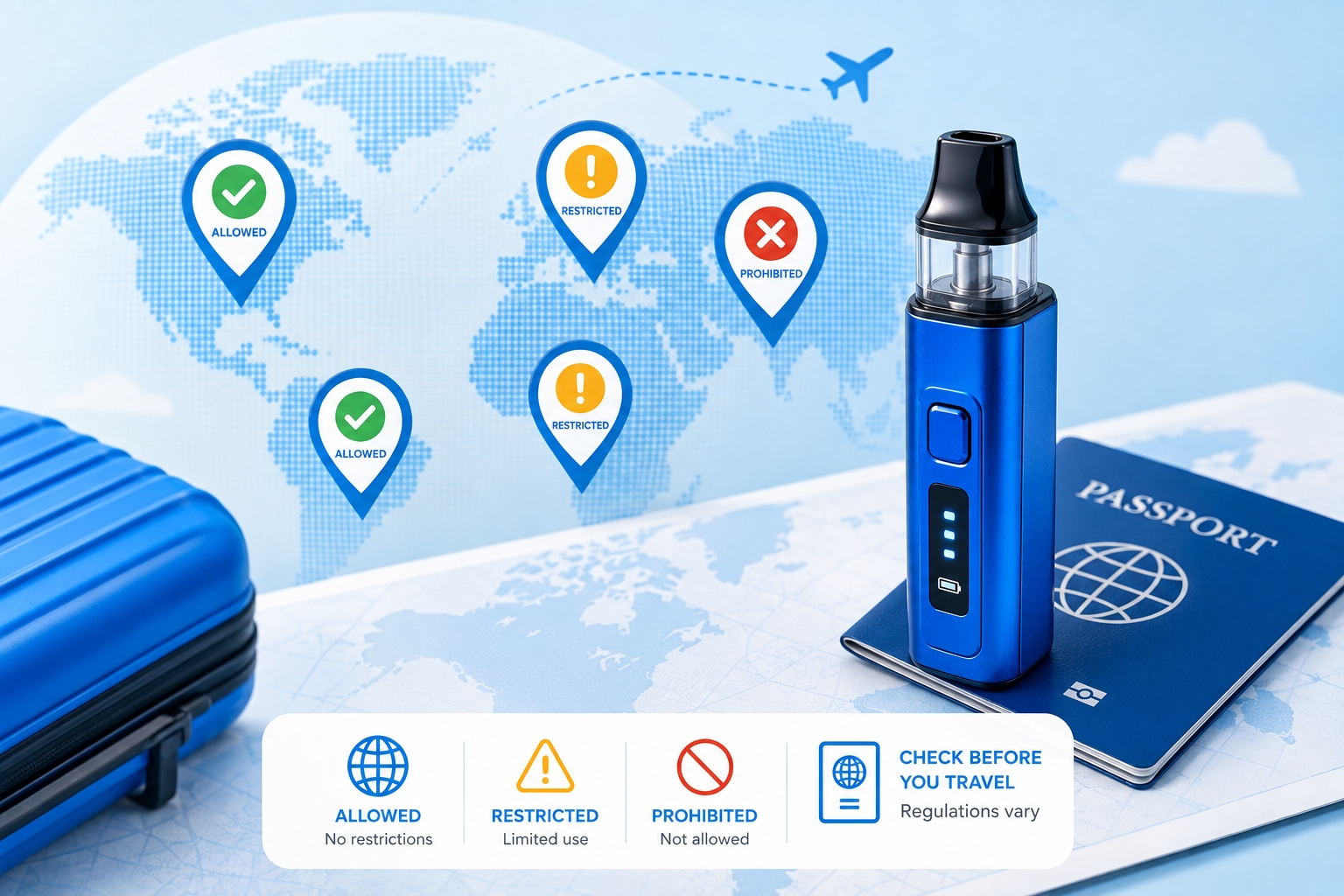
Travel regulations can change quickly. Airline baggage rules, airport-security requirements, customs laws, import restrictions, and local vaping laws are separate issues. Always verify your departure country, destination, transit airports, airline, and official customs or government guidance before traveling. This guide is general information, not legal advice.
Packing a vape for an international trip involves more than deciding whether it belongs in your carry-on. A device may satisfy airline battery rules but still be prohibited from entering your destination country.
The safest approach is to check three separate layers before departure: aviation rules, customs/import rules, and local possession or use laws. Transit points matter too, especially if your connection requires you to clear immigration, collect baggage, or formally enter the country.
The Aviation Rule Comes First: Vapes Belong in Carry-On Baggage
International aviation guidance treats battery-powered electronic smoking devices differently from many ordinary electronics because of their lithium batteries and heating elements.
The International Air Transport Association (IATA) states that electronic cigarettes and personal vaporizers containing batteries must be carried in carry-on baggage only. Measures must also be taken to prevent accidental activation, and the device or its batteries must not be recharged on board the aircraft.
The Federal Aviation Administration (FAA) applies the same core rule for U.S. aviation: electronic smoking devices must remain on the passenger or in carry-on baggage rather than checked baggage.
The International Civil Aviation Organization (ICAO) also treats battery-powered electronic smoking devices as carry-on items rather than checked-baggage items.
Gate-check warning: If an airline takes your carry-on at the gate and sends it to the aircraft hold, remove the vape device, spare lithium batteries, and other items the airline requires to remain in the cabin before surrendering the bag.
How to Pack the Device and Batteries for a Flight
- Prevent accidental activation: Power the device off or use its locking mechanism, protective cover, or another effective method appropriate for the device.
- Protect spare batteries individually: Exposed terminals should not contact coins, keys, other batteries, or metal objects.
- Use protective battery cases: Loose removable cells should be individually protected against short circuits.
- Do not recharge the vape in flight: Aviation guidance prohibits charging electronic smoking devices aboard the aircraft.
- Do not pack damaged batteries: Damaged, defective, or recalled lithium batteries may be prohibited from carriage.
- Check the airline: Airlines can apply additional restrictions beyond baseline aviation requirements.
Proper terminal protection is already part of basic vape battery safety, but air travel adds another layer of requirements because lithium-battery incidents must be manageable by cabin crew.
What About E-Liquid in Carry-On Baggage?
E-liquid is treated separately from the vaping device because airport liquid-security limits may apply.
For passengers passing through U.S. security screening, the Transportation Security Administration (TSA) applies its standard carry-on liquid restrictions. Other countries and airports may have different screening procedures, so travelers should check the rules applying to every airport on their itinerary.
Countries Where Travelers Should Be Especially Careful
Country rules are more complicated than a simple “legal” or “banned” label. Import, possession, sale, transit, and personal use can be regulated differently. The examples below focus on rules that can directly affect international travelers.
Singapore
Singapore is one of the clearest examples where ordinary airline carriage rules do not make a vape lawful at the destination. The Health Sciences Authority of Singapore states that the purchase, possession, use, and importation of vaporisers are prohibited. Travelers should therefore not treat a vape as an ordinary personal electronic item when entering Singapore.
Hong Kong
Hong Kong places strict restrictions on importing electronic cigarettes and other alternative smoking products. The Hong Kong Customs and Excise Department also distinguishes certain passengers who remain in airport transit without passing through immigration control.
That distinction matters because an airside connection is not necessarily treated the same way as entering Hong Kong, clearing immigration, or leaving the secure transit area.
Thailand
The Thai Customs Department identifies electronic cigarettes as prohibited imports. A device permitted in the aircraft cabin should therefore not be assumed to be legal to bring through Thai customs.
India
India’s Prohibition of Electronic Cigarettes Act, 2019 prohibits activities including the production, manufacture, import, export, transport, sale, distribution, storage, and advertising of electronic cigarettes. Because import and transport are specifically covered, airline permission should not be treated as permission to bring a personal vape into India.
Brazil
Brazil’s Anvisa regulation maintains restrictions covering the manufacture, import, commercialization, distribution, storage, transport, and advertising of electronic smoking devices. Official guidance also addresses products brought into Brazil for personal use, making the country particularly important to check before departure.
Australia
Australia does not fit neatly into a simple “legal” or “banned” category. Vapes are regulated through a therapeutic framework, while importation is tightly controlled.
The Therapeutic Goods Administration (TGA) provides a traveler exemption under specific conditions for therapeutic vaping goods brought into Australia by people arriving by aircraft or ship.
| Australian Traveler Exemption | Maximum Quantity |
|---|---|
| Vapes | 2 devices |
| Cartridges, capsules, or pods | 20 |
| Vape substance in liquid form | 200 mL |
These quantities do not mean every vape automatically qualifies. The exemption has specific conditions, including therapeutic-use requirements, and state or territory rules may also apply.
Japan: More Nuanced Than a Simple Nicotine-Vape Ban
Japan is often described online as completely banning nicotine e-liquid, but travelers should be careful with that simplification. Nicotine-containing e-cigarette products fall within Japan’s pharmaceutical regulatory framework, and personal importation can be treated differently from domestic commercial sale.
Travelers carrying nicotine-containing products should confirm current personal-import quantities and procedures with Japanese authorities before departure rather than assuming either unrestricted entry or a complete prohibition.
Disposable Vape Bans Do Not Always Mean Traveler Possession Is Banned
A common mistake in travel guides is treating a retail or supply ban as though it automatically creates an identical traveler-possession ban. The exact legal wording matters.
United Kingdom
The UK banned the sale and supply of single-use vapes from June 1, 2025. This should not automatically be rewritten as a blanket prohibition on traveler possession because sale, supply, import, and possession are separate legal concepts.
France
France prohibited the sale, distribution, and free supply of disposable electronic cigarettes in 2025. Travelers should distinguish these market restrictions from any separate customs or possession requirements.
Belgium
Belgium prohibits placing disposable electronic cigarettes on the market. Travelers should still verify separate import, customs, and possession requirements rather than assuming the retail rule answers every travel question.
New Zealand
New Zealand restricts the sale, manufacture, supply, and distribution of disposable vaping devices. A reusable pod system may avoid some disposable-specific product restrictions, but being refillable or rechargeable does not automatically make a device lawful to import, possess, or use in every destination.
European Union: The 20 mg/mL Rule Needs Context
The EU Tobacco Products Directive establishes a maximum nicotine concentration of 20 mg/mL for nicotine-containing e-liquid placed on the EU market.
That product-market requirement should not automatically be interpreted as a universal personal-baggage allowance. Individual EU member states can apply additional rules involving disposables, flavors, public use, taxation, product availability, or importation.
Your Layover Can Change the Answer
A connection is not always legally equivalent to entering a country. Whether local import restrictions affect a transit passenger can depend on how the airport and country define transit.
- Will you remain entirely airside?
- Will you pass through immigration?
- Will you collect and re-check baggage?
- Will you change airports or terminals requiring entry?
- Will you stay overnight outside the secure transit area?
Hong Kong is a useful example because official customs guidance distinguishes certain airside transit passengers from travelers formally entering the territory. Other jurisdictions can apply different rules, so never assume one country’s transit exception applies everywhere.
Airline Permission Does Not Equal Customs Permission
| Authority | What It Controls | Typical Question |
|---|---|---|
| ICAO / IATA / aviation authority | Lithium-battery and dangerous-goods carriage | Carry-on or checked baggage? |
| Airport security | Checkpoint screening and liquid limits | How much liquid can pass security? |
| Airline | Carrier-specific baggage policies | Does the airline impose additional restrictions? |
| Customs / border authority | What may legally enter the country | Can I bring the device across the border? |
| National or local government | Possession, age, sale, and public-use rules | Can I possess or use it after arrival? |
Practical Pre-Flight Vape Checklist
- Check destination customs rules: Look specifically for electronic cigarettes, vaporizers, nicotine liquids, cartridges, and accessories.
- Check every transit country: This matters especially when clearing immigration or leaving the secure transit area.
- Check your airline: Carrier rules may be stricter than baseline aviation requirements.
- Keep the device out of checked baggage: Battery-powered electronic smoking devices are generally required to remain in carry-on baggage or on the passenger.
- Protect spare batteries: Prevent battery terminals from contacting metal objects or other batteries.
- Prevent accidental activation: Power off or lock the device before boarding.
- Do not charge it in flight: Aviation guidance prohibits onboard charging of electronic smoking devices.
- Check liquid limits: E-liquid is subject to applicable airport-security rules.
- If official rules are unclear, leave it behind: Do not rely solely on forum posts, social media, or another traveler’s previous experience.
Final Thoughts
There is no single worldwide rule for traveling with a vape. Aviation authorities may permit the device in cabin baggage while the destination’s customs authority prohibits its import entirely.
Before every international trip, verify the airline, airport-security, customs, transit, and destination rules separately. Those distinctions are more reliable than broadly labeling a country as simply “vape-friendly” or “vape-banned.”
Official Sources & Further Reading
- IATA — Passengers Travelling With Lithium Batteries
- FAA PackSafe — Electronic Cigarettes and Vaping Devices
- ICAO — Dangerous Goods Guidance
- TSA — What Can I Bring?
- Singapore HSA — Vaporiser Enforcement
- Hong Kong Customs — Alternative Smoking Products
- Thai Customs — Electronic Cigarette Import Restrictions
- India Code — Prohibition of Electronic Cigarettes Act, 2019
- Brazil Anvisa — Electronic Smoking Device Regulation
- Australian TGA — Vapes for Travelers
- UK Government — Single-Use Vape Ban
- New Zealand Ministry of Health — Disposable Vaping Device Rules
- EUR-Lex — EU Tobacco Products Directive
Last reviewed: September 2026. Regulations can change without notice. Airline acceptance does not establish that a vaping device may legally be imported, possessed, or used at your destination. Confirm current requirements directly with your airline and the official customs, civil aviation, embassy, or government authority responsible for each country on your itinerary.