 United States

Vape Tank O-Rings Explained: Wear, Compatibility, and Replacement Signs
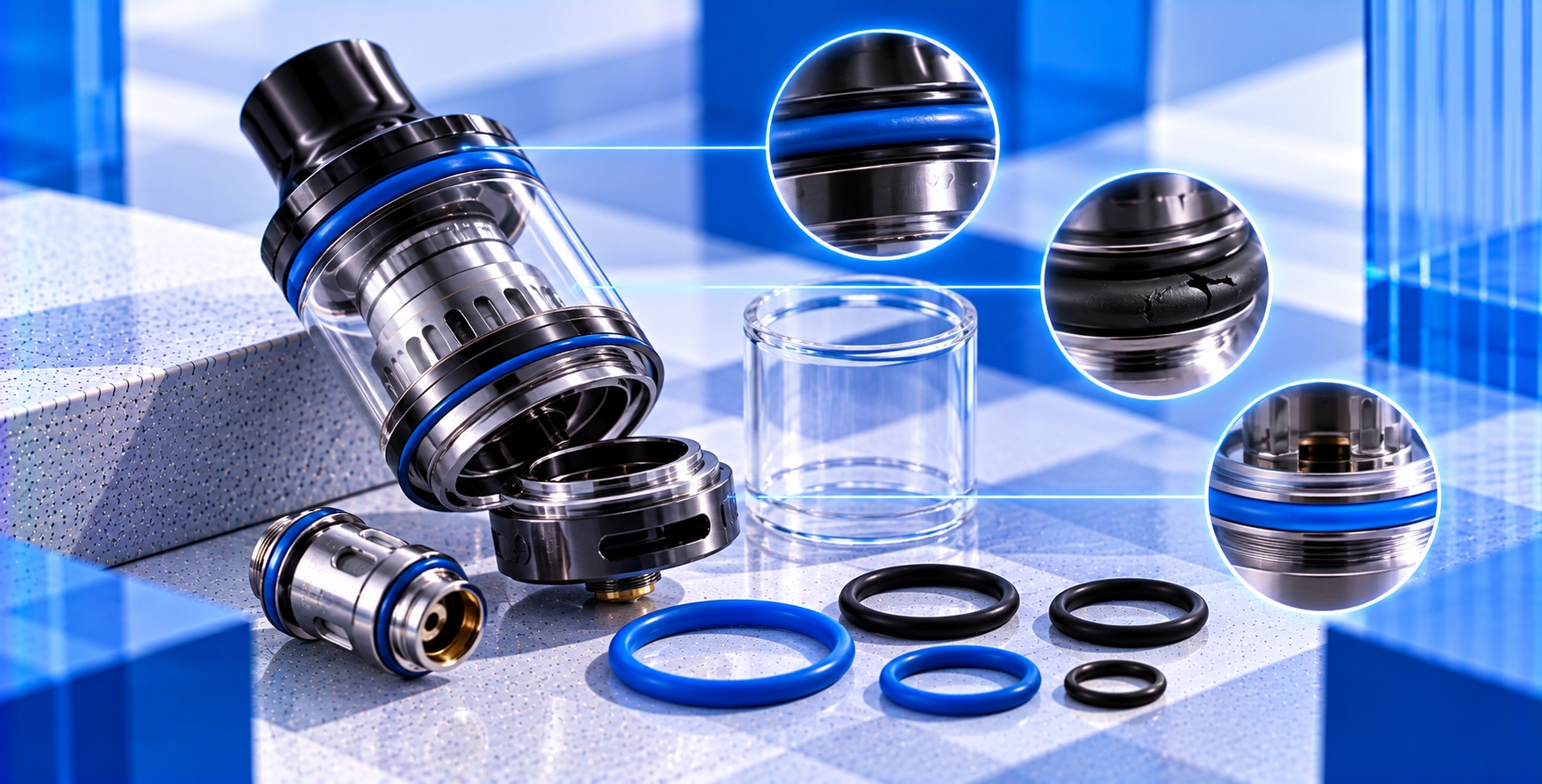
A small rubber-like ring inside a vape tank can make a significant difference in how its components fit together. These rings, commonly called O-rings, help seal the joints between certain tank components and keep e-liquid inside the reservoir.
Over time, an O-ring may become stretched, flattened, cracked, displaced, or damaged during disassembly. When a seal no longer fits correctly, the tank may develop gaps or leaks even when the glass, coil, and other components appear intact.
This guide explains what vape tank O-rings do, where they are commonly located, how to recognize wear, why replacement compatibility matters, and what to check before reinstalling a seal.
Quick Answer: What Are Vape Tank O-Rings?
Vape tank O-rings are small, flexible sealing components positioned between certain parts of a refillable tank. They help close gaps around the glass reservoir, top cap, base, or other connections where a liquid-tight seal is required.
An O-ring works by fitting into a designed groove or sealing surface and compressing between adjoining components. The correct amount of compression helps form a seal without requiring excessive force.
Not every vape tank uses identical O-rings. Some models also use flat gaskets, silicone plugs, or specially shaped seals instead of conventional circular O-rings.
Where Are O-Rings Located in a Vape Tank?
The number and position of O-rings depend on the tank's construction. Some tanks use several separate seals, while others rely on integrated sealing components.
| Location | Typical Function | Possible Problem |
|---|---|---|
| Upper glass connection | Helps seal the glass against the upper tank assembly | Liquid escaping around the top of the glass |
| Lower glass connection | Helps seal the reservoir against the base | Leakage around the bottom of the glass |
| Top cap or filling assembly | Helps close the filling system | Liquid escaping near the cap or fill opening |
| Coil or base interface | Helps seal certain replaceable coil or base connections | Liquid bypassing a damaged or displaced seal |
These are common examples, not a universal tank layout. Refer to the official exploded diagram or parts list for the exact seal positions in your model.
For a broader explanation of tank components, Vape.com's vape tank anatomy guide identifies the reservoir, coil, airflow components, seals, and their general functions.
What Causes Vape Tank O-Rings to Wear Out?
1. Repeated Compression and Mechanical Wear
O-rings are designed to deform within a specific sealing space. Over time, some elastomer materials can develop compression set, meaning the seal does not fully return to its original shape after prolonged compression.
Repeated assembly, disassembly, and mechanical movement can also contribute to wear. A seal that has become permanently flattened may no longer provide the intended fit.
The rate of deterioration depends on the material, seal design, temperature, chemical exposure, and how the tank is handled.
2. Stretching During Removal or Installation
An O-ring may stretch when it is pulled over a tank component or removed from its groove. Excessive stretching can distort the seal or prevent it from returning to its intended dimensions.
If a seal becomes noticeably loose, elongated, or unable to sit correctly in its groove, it may need replacement.
Avoid pulling, twisting, or stretching seals beyond the procedure described in the manufacturer's maintenance instructions.
3. Cuts, Pinching, or Abrasion
An O-ring can become cut or pinched if it is trapped between misaligned components or dragged across a sharp edge during assembly.
Threaded parts, glass edges, and retaining grooves can create contact points where improper installation damages the seal.
Even a small tear may interfere with the sealing surface. A visibly cut or split O-ring should not be reused.
4. Exposure to Unsuitable Cleaning Chemicals
O-ring materials differ in their resistance to cleaning agents and other chemicals. Some elastomers can swell, harden, soften, or otherwise deteriorate when exposed to incompatible substances.
Do not assume that alcohol, strong detergents, essential oils, or other solvents are safe for every vape tank seal.
Follow the tank manufacturer's cleaning instructions and use only cleaning products approved for the specific materials involved.
5. Heat and Material Aging
Heat and environmental exposure can affect the long-term properties of elastomer seals. Depending on the material and conditions, aging may contribute to hardening, cracking, loss of elasticity, or changes in dimensions.
Avoid exposing the tank to temperatures outside the manufacturer's specified limits. Do not attempt to restore a worn O-ring by heating, boiling, or applying an unapproved lubricant.
Signs Your Vape Tank O-Ring May Need Replacement
An O-ring does not need to be visibly broken to have a sealing problem. However, several physical changes can indicate that it no longer fits or functions as intended.
| Warning Sign | What It May Indicate | Recommended Action |
|---|---|---|
| Visible cracks or tears | Physical seal damage | Replace with the specified compatible seal |
| Flattened or permanently compressed shape | Possible compression set | Compare with manufacturer specifications |
| Stretched or loose fit | Dimensional change or deformation | Do not force or reuse an incorrectly fitting seal |
| Swelling or unusual softness | Possible material incompatibility or deterioration | Replace and review approved cleaning methods |
| Repeated leakage at a sealed joint | Displaced, damaged, or incorrectly fitted seal | Inspect the seal and surrounding components |
| Missing O-ring | Incomplete tank assembly | Do not use the tank until the correct seal is installed |
Leakage alone does not prove that an O-ring is defective. Cracked glass, incorrect coil installation, damaged threading, or improper assembly can produce similar symptoms.
Vape Tank O-Ring Compatibility: Why Size and Material Matter
O-rings may look interchangeable, but their dimensions, material, shape, and intended sealing position can differ between tank models.
A replacement that looks close to the original may still be too thin, too thick, too large, or too small to seal correctly.
O-Ring Diameter and Thickness
Conventional O-rings are commonly specified using their inside diameter and cross-sectional thickness. These dimensions determine how the ring fits into its groove and how it compresses against surrounding surfaces.
Using an incorrectly sized O-ring can result in inadequate compression, excessive compression, twisting, or poor seating.
Do not select a replacement based only on visual similarity. Use the manufacturer's part number, service documentation, or an approved replacement kit for the exact tank model.
O-Ring Material Compatibility
O-rings can be manufactured from different elastomer materials, including silicone and other synthetic rubbers. Each material has its own properties and limitations.
Material suitability depends on the seal's intended operating conditions and the substances it may contact. A seal being described as silicone or rubber does not automatically establish compatibility with every tank, cleaning product, or e-liquid formulation.
Use manufacturer-specified replacement seals rather than choosing an alternative material without documented compatibility.
Tank Model and Component Compatibility
Two tanks from the same manufacturer may use different glass dimensions, seal grooves, or retaining systems. Even different versions of one tank family can have different replacement requirements.
Check the full model name, version, and official parts documentation before selecting a replacement.
For general component-matching principles, Vape.com's vape compatibility guide explains why similar-looking parts are not necessarily interchangeable.
Can You Use Any O-Ring in a Vape Tank?
No. A generic O-ring should not be assumed compatible simply because it fits around a tank component.
Correct sealing depends on the ring's dimensions, material, groove design, and intended compression. A replacement that is too small may stretch excessively, while one that is too thick may interfere with assembly or place unwanted pressure on surrounding components.
The safest choice is the exact manufacturer-approved replacement for the tank. If no compatible seal is available, consult the manufacturer rather than modifying the reservoir or improvising a substitute.
How to Check and Replace a Vape Tank O-Ring
O-ring replacement should only be performed when the tank manufacturer identifies the seal as user-replaceable and provides an appropriate procedure.
- Identify the exact tank model. Consult the official manual or replacement-parts diagram to confirm which seals are intended to be removed.
- Turn off the device and detach the tank. Follow the manufacturer's handling instructions and keep e-liquid away from the device's electrical components.
- Empty the reservoir as instructed. Avoid spilling e-liquid onto electronics or exposing it to children and pets.
- Disassemble only user-serviceable components. Do not pry apart sealed sections or force components that are not designed to separate.
- Inspect the accessible seal and groove. Look for cracks, stretching, deformation, residue, or damage to the surrounding glass and retaining surfaces.
- Use the exact compatible replacement. Follow the manufacturer's procedure for positioning the O-ring without twisting, cutting, or stretching it excessively.
- Reassemble according to the manual. Avoid overtightening, cross-threading, or forcing the glass against the seal.
- Confirm the tank is correctly assembled. Follow the manufacturer's checks before returning it to normal use. If the seal will not seat correctly or leakage persists, discontinue use.
If the tank has cracked glass, damaged threads, or distorted sealing surfaces, replacing the O-ring alone may not resolve the problem.
Why Is My Vape Tank Still Leaking After Replacing an O-Ring?
A new O-ring does not guarantee that a tank will stop leaking. The replacement may be incompatible, incorrectly positioned, or unable to seal against a damaged surface.
Other causes include cracked glass, improper coil seating, damaged threading, an incorrectly closed fill port, or liquid entering an airflow passage.
If leakage continues after replacing the correct seal, inspect the remaining user-serviceable components according to the manufacturer's instructions.
Vape.com's tank leak troubleshooting guide covers the broader causes of leaking, including coil installation, filling technique, airflow pathways, and reservoir damage.
How Often Should Vape Tank O-Rings Be Replaced?
There is no universal replacement interval for every vape tank O-ring. Service life depends on the seal material, design, compression, cleaning methods, temperature exposure, and frequency of disassembly.
Some seals remain functional for extended periods, while others may be damaged during maintenance or deteriorate sooner under unfavorable conditions.
Rather than replacing seals according to an arbitrary number of weeks or months, follow the manufacturer's maintenance schedule and replace user-serviceable O-rings when they show damage, deformation, poor fit, or other specified replacement indicators.
How to Reduce Premature O-Ring Wear
Proper handling and manufacturer-approved maintenance can help reduce avoidable seal damage.
- Use the correct O-ring for the exact tank model.
- Follow the manufacturer's disassembly and reassembly instructions.
- Avoid overtightening threaded tank components.
- Do not pull or stretch seals unnecessarily.
- Keep sealing surfaces free from visible debris using approved cleaning methods.
- Avoid unapproved solvents, adhesives, and lubricants.
- Check accessible seals for damage during routine maintenance.
- Replace damaged seals rather than attempting to reshape or repair them.
A clean tank can make seal inspection easier, but cleaning cannot restore an O-ring that has cracked, permanently flattened, or lost its intended dimensions.
Frequently Asked Questions
What does an O-ring do in a vape tank?
An O-ring helps seal the joint between certain tank components. Depending on the design, it may be located around the glass, base, top cap, or another connection where the manufacturer requires a liquid-tight seal.
How do I know if my vape tank O-ring is bad?
Possible signs include visible cracks, cuts, stretching, flattening, swelling, poor fit, or leakage around a sealed joint. However, leaking can also result from other tank problems, so the seal and surrounding components should be inspected together.
Are vape tank O-rings universal?
No. O-rings differ in diameter, thickness, material, and intended application. Use the manufacturer-specified replacement for the exact tank model rather than assuming that a similar-looking ring will fit.
Can a missing O-ring cause a vape tank to leak?
Yes. If the tank design requires an O-ring at a particular joint, a missing seal may allow e-liquid to escape or prevent the components from assembling correctly. Do not use the tank until the correct seal is installed.
Can I reuse an old vape tank O-ring?
An existing O-ring may remain usable if the manufacturer permits reuse and it is undamaged, correctly sized, and properly seated. Replace it if it shows cracking, deformation, stretching, or other signs that it no longer meets the intended fit.
Can I use a thicker O-ring to stop leaking?
Do not substitute a thicker seal unless the manufacturer explicitly specifies it. Excessive seal thickness can interfere with assembly, create unwanted compression, or prevent tank components from fitting as designed.
Why is my vape tank leaking even with a new O-ring?
The replacement may be the wrong size, incorrectly seated, or unable to seal against a damaged surface. Leakage may also come from the coil, glass, filling system, or another component. Follow the manufacturer's troubleshooting instructions.
Do I need to replace all O-rings at the same time?
Not necessarily. Follow the manufacturer's maintenance guidance. Some replacement kits include multiple seals, but whether they should be replaced together depends on the tank design, service instructions, and condition of each component.
Final Verdict
Vape tank O-rings are small components with an important sealing function. Their condition, dimensions, material, and placement all affect how correctly the tank assembles and retains e-liquid.
Cracks, permanent flattening, stretching, swelling, or poor seating may indicate that a seal needs replacement. However, an O-ring should not automatically be blamed for every tank leak, since other components can produce similar symptoms.
When replacement is necessary, use the exact manufacturer-specified seal and follow the tank's approved maintenance procedure. If the tank remains damaged or cannot be assembled correctly, discontinue use rather than improvising a repair.
Sources & Further Reading
- Parker Hannifin — O-Ring Engineering and Elastomer Sealing Resources
- Vaporesso — Official Tank Manuals and Support
- Geekvape — Official Product Documentation
- Vape.com — How to Clean and Maintain Your Vape Tank
Last reviewed: October 31, 2026. This article is intended for adult users of legal purchasing age and provides general information about vape tank sealing components. O-ring dimensions, materials, serviceability, and replacement procedures vary by manufacturer and model. Always follow the official instructions for your specific tank.