 United States

How Vape Pod Connections Work: Contacts, Detection & Compatibility
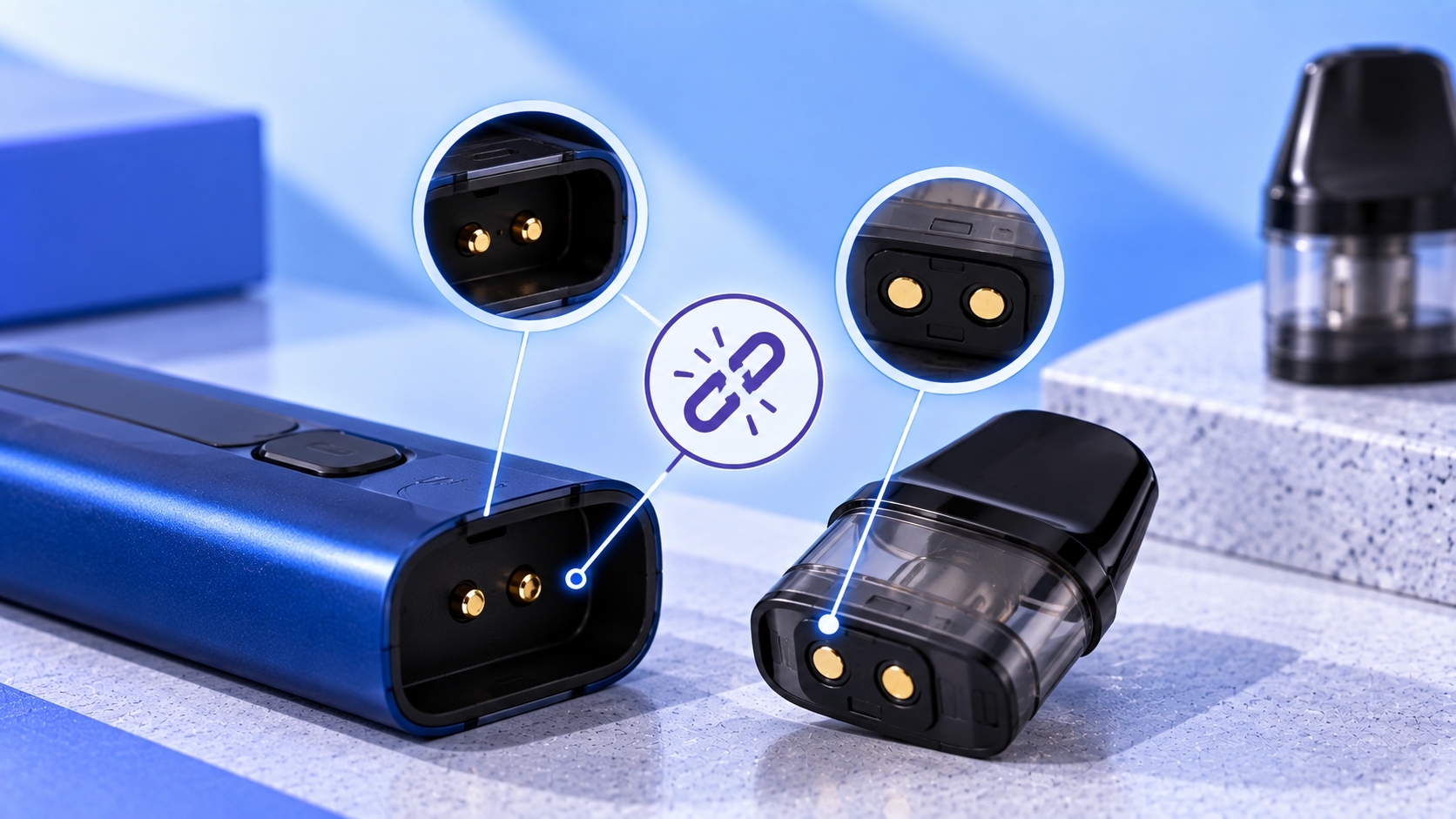
Note: Vape pod connection designs vary by manufacturer and model. This article explains general connection principles, not instructions for modifying electrical hardware. Consult the official manual for your device's contact layout, compatible cartridges, and protection behavior.
A vape pod connects to its device through more than a simple physical fit. The cartridge must sit in the correct position while its conductive components establish the electrical connection required for the device to recognize and operate with the installed coil.
Some pod systems use magnets for retention, others rely on mechanical fittings, and many incorporate dedicated metal contacts between the cartridge and battery section.
Understanding these connection components helps explain why cartridges are model-specific and why a pod can appear correctly installed without being electrically recognized.
This guide explains how vape pod connections work, how devices detect installed coils, and what determines cartridge compatibility.
How Does a Vape Pod Connect to the Device?
A typical pod system includes a removable cartridge and a battery-powered device section. The cartridge contains the liquid reservoir and coil assembly, while the device supplies controlled electrical power when its operating conditions are satisfied.
The connection normally depends on two separate functions:
- Mechanical positioning: The pod must fit and remain seated in its intended location.
- Electrical contact: Conductive points must connect the coil assembly to the device's electrical circuit.
These functions are related but not interchangeable. A pod can be held securely in place while still having an incomplete electrical connection.
What Are Vape Pod Contact Points?
Contact points are conductive surfaces that establish the electrical interface between the cartridge and the device.
Depending on the design, the pod may use flat metal pads, while the device contains fixed or spring-loaded contact pins.
When the cartridge is installed correctly, these surfaces align to complete the intended electrical path through the coil assembly.
Contact geometry, spacing, materials, and placement differ across manufacturers. Similar-looking cartridges therefore do not necessarily share the same connection design.
What Do Magnets Do in a Vape Pod System?
Many pod systems use magnets to help position or retain the cartridge inside the device.
Their primary role is mechanical: they help keep the pod seated in its intended location.
In typical magnetic-retention designs, dedicated conductive contacts establish the electrical connection. Magnetic retention alone does not confirm that the device has successfully detected the coil.
Other pod systems use snap-fit or friction-based retention rather than magnets. The exact mechanism depends on the manufacturer.
How Does a Vape Detect an Installed Pod?
In many regulated pod systems, the control electronics monitor the electrical characteristics of the connected coil or atomizer.
When the pod is correctly installed and the electrical path is established, the device may detect the coil's resistance and determine whether the connected hardware is within its supported operating conditions.
The device may then allow normal activation, display a resistance value, or indicate that a compatible cartridge is present.
This behavior is not universal. Some systems use additional detection methods, and manufacturers may implement recognition and protection differently.
What Role Does Coil Resistance Play in Pod Detection?
Electrical resistance describes how strongly a component opposes current flow and is measured in ohms (Ω).
A regulated device may use the detected coil resistance as part of its electrical monitoring and protection system.
For example, a device may refuse normal activation if it cannot detect an expected electrical load or if the measured resistance falls outside the manufacturer's supported range.
Resistance alone does not establish full compatibility. A cartridge must also meet the device's physical, electrical, and manufacturer-defined requirements.
Why Are Vape Pods Not Universally Compatible?
Pod compatibility depends on several design characteristics rather than appearance alone.
These can include cartridge dimensions, retention mechanisms, contact placement, coil construction, resistance range, and device generation.
Two cartridges may look nearly identical but use different electrical contact arrangements or supported coil systems.
The most reliable approach is to check the manufacturer's supported cartridge list for the exact model. Vape.com's pod compatibility article explains how to identify matching device components.
Integrated Coils vs. Replaceable Coils: Does the Connection Differ?
Some cartridges contain a permanently integrated coil. Others are designed to accept a separate replaceable coil head.
With an integrated-coil cartridge, the coil and pod are generally replaced as one assembly.
In replaceable-coil systems, the coil must also be correctly installed within the cartridge according to the manufacturer's instructions.
An incorrectly installed or incompatible replacement coil can affect the electrical path even when the cartridge itself fits the device.
What Happens When a Vape Pod Is Not Detected?
If the device cannot establish the expected electrical connection, it may prevent activation or display a manufacturer-specific warning.
Depending on the model, this may appear as a No Pod, Check Pod, No Atomizer, or similar message.
A device without a screen may communicate the condition through an LED pattern, although LED indicators vary by manufacturer.
A missing connection may result from several different conditions, so the warning should not be treated as proof that one particular component has failed. Vape.com's atomizer detection article addresses that error separately.
How Pod Connection Designs Differ
| Component | Main Function | Important Distinction |
|---|---|---|
| Magnetic retention | Helps position and hold the pod | Does not independently confirm coil detection |
| Mechanical fitting | Maintains physical seating | Physical fit does not guarantee compatibility |
| Electrical contact pads | Provide conductive connection surfaces | Must align with the device interface |
| Spring-loaded pins | Maintain contact in supported designs | Not present in every pod system |
| Coil assembly | Provides the heating element | Must meet electrical and compatibility requirements |
| Control electronics | Monitor electrical conditions and manage output | Detection behavior is model-specific |
How to Identify a Pod Connection Problem
If a device fails to recognize a cartridge, start with the manufacturer's compatibility and installation instructions.
A limited external inspection may help identify obvious problems:
- Confirm that the pod is specifically compatible with the device model.
- Turn off the device if supported and disconnect it from charging.
- Remove the cartridge according to the manufacturer's instructions.
- Inspect accessible contact surfaces for visible moisture, residue, or damage.
- Follow the manufacturer's cleaning and drying instructions where applicable.
- Reinstall the pod normally without forcing it.
- Check any screen warning or LED response against the official manual.
If the cartridge is cracked, deformed, leaking into the device, or visibly damaged, the pod needs replacing according to the manufacturer's guidance.
Do not bend contact pins, insert conductive materials, or modify the cartridge to restore recognition.
When Is a Connection Problem a Device Fault?
If multiple known-compatible cartridges fail to connect in the same device, a device-side contact or internal electrical problem becomes more plausible.
However, this comparison does not identify the exact failed component. Manufacturer inspection or service may be required.
Stop using the device if the connection area or battery housing is damaged, liquid has entered the battery section, the device overheats, or an electrical protection warning persists.
Final Thoughts
Vape pod connections rely on compatible physical positioning and an appropriate electrical interface between the cartridge, coil, and device.
Magnets or mechanical fittings help retain the cartridge, while conductive contacts establish the electrical connection. The device's control electronics may then monitor coil resistance and other conditions to determine whether normal operation is permitted.
Because these systems vary by manufacturer, always verify cartridge compatibility and follow the official manual rather than relying on appearance alone.
Sources & Further Reading
- Vaporesso — Device FAQ and Troubleshooting
- Vaporesso — XROS 4 Nano User Manual
- U.S. FDA — Vape Battery Safety
Safety reminder: Never force incompatible cartridges, modify electrical contacts, or bypass device protection features. Follow the manufacturer's instructions for the exact device and stop using damaged hardware.