 United States
Coil Building 101: Wire Types, Wicking Materials, and Flavor Chemistry
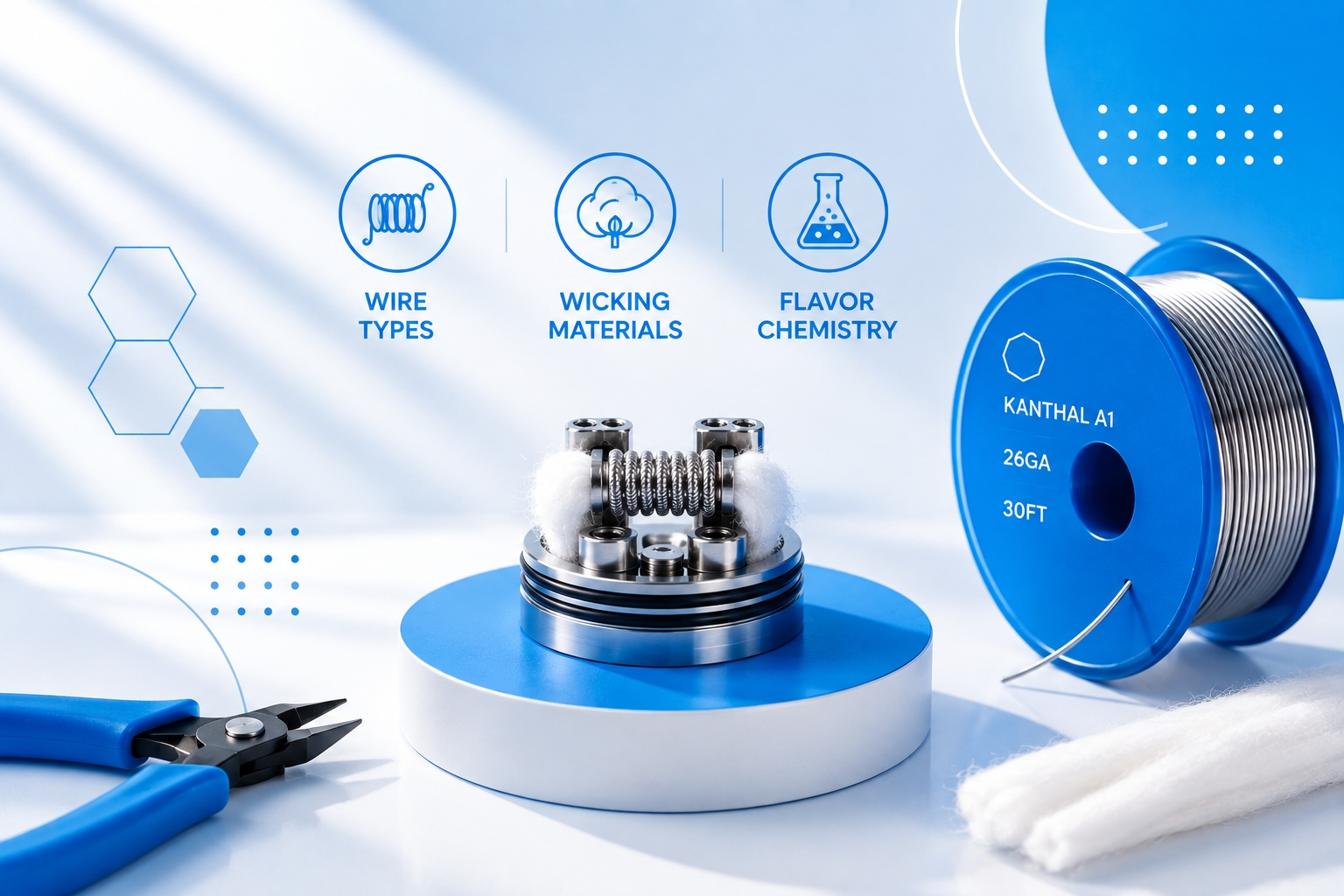
Coil building is intended for experienced users of rebuildable devices. Resistance, power, coil material, wicking, battery limits, and device configuration interact in ways that can affect both performance and aerosol formation. Always follow the specifications of your atomizer, mod, wire, and battery, and verify a new build before use.
If you've been vaping for a while, you've probably noticed that changing a coil can noticeably change vapor production, ramp-up behavior, and the way an e-liquid tastes. That's because the heating element isn't working alone — coil material, resistance, power, surface area, airflow, e-liquid supply, and wick condition all interact during aerosol generation.
Coil building therefore sits at the intersection of electrical behavior, heat transfer, and hands-on setup. Rather than looking for one universally "best" build, it makes more sense to understand how each variable affects the overall system.
Why Build Your Own Coils?
Pre-built replacement coils offer convenience and predictable manufacturer specifications. Rebuildable atomizers, on the other hand, give experienced users greater control over characteristics such as:
- Coil resistance
- Wire material and gauge
- Number and diameter of wraps
- Coil surface area
- Wicking material and density
- Power and temperature-control settings
That flexibility also introduces more variables. Before experimenting with a custom build, understanding Ohm's Law and the operating limits of your device and battery is more important than simply targeting a particular resistance number.
Wire Types: The Backbone of Your Build
Heating-coil materials differ in electrical resistance and temperature-dependent behavior. Wire gauge, length, coil geometry, power setting, airflow, and liquid supply also influence how a finished build behaves.
Research on electronic-cigarette heating elements also shows why simple statements such as "one wire always produces better flavor" should be treated cautiously. Experimental studies have found that coil material, power, temperature, age, and device configuration can influence aerosol chemistry, with results varying by test conditions.
Kanthal (FeCrAl)
Kanthal is widely used as a resistance wire in wattage-controlled vaping devices. It holds its shape relatively well during building and is commonly used for straightforward wattage-mode builds.
Kanthal is generally not used for conventional temperature-control operation because its resistance changes relatively little with temperature compared with materials designed for TC measurement.
Nichrome
Nichrome is another resistance-wire material used in vaping coils. Depending on alloy, gauge, and coil geometry, it can produce a different resistance and ramp-up response than an equivalent Kanthal build.
Rather than assuming Nichrome automatically produces larger clouds or requires less wattage, builders should calculate and verify the completed build and operate it within the specifications of the device and wire.
Stainless Steel
Certain stainless-steel alloys, including SS316L, are commonly used because compatible devices may operate them in either wattage or temperature-control modes.
Actual temperature-control compatibility depends on the mod's supported materials and settings, so the device manufacturer's documentation should determine whether a particular stainless-steel wire is appropriate.
Nickel and Titanium
Nickel and titanium wires have historically been used with compatible temperature-control systems because their resistance changes with temperature in a way the device can monitor.
These materials require appropriate TC-capable hardware and should only be used according to the wire and device manufacturer's specifications. They shouldn't be treated as interchangeable with ordinary wattage-mode resistance wire.
Quick comparison:
| Wire Type | Typical Use | TC Use | Key Consideration |
|---|---|---|---|
| Kanthal | Wattage mode | Generally no | Common resistance wire that holds its shape well |
| Nichrome | Wattage mode | Generally no | Resistance and response depend on alloy, gauge, and geometry |
| Stainless Steel | Wattage or compatible TC setups | Yes, with compatible hardware | Check alloy and mod compatibility |
| Nickel / Titanium | Compatible TC setups | Yes | Requires appropriate TC settings and handling |
Wicking Materials Matter Too
The coil generates heat, but the wick continuously supplies e-liquid to the heating surface. Poor liquid delivery can allow sections of a coil to become significantly hotter than they would under fully saturated conditions.
A laboratory study published in PLoS ONE via PubMed measured substantial differences in coil temperature depending on power, resistance, e-liquid composition, and especially coil wetness. The researchers concluded that efficient delivery of e-liquid to the heating coil is an important factor affecting operating temperature.
Cotton
Cotton is commonly used in rebuildable atomizers because it can absorb and transport e-liquid while being relatively easy to replace. Performance depends heavily on how much material is installed and how effectively liquid reaches the coil.
Too much wick can restrict liquid flow, while too little may contribute to leaking or inconsistent saturation. Correct density therefore depends on the coil, atomizer, and manufacturer guidance rather than a universal amount.
Rayon
Rayon is another cellulose-based material used by some builders. Its behavior differs from cotton, so packing technique may need to be adjusted rather than applying the same amount or density automatically.
Silica
Silica wick appeared frequently in earlier atomizer designs and remains relevant when discussing the development of vaping hardware. Modern rebuildable setups, however, more commonly use cotton or other wick materials specifically intended for the atomizer.
Why Coil Temperature and Saturation Matter
The chemistry of aerosol formation is more complicated than saying that each flavor or nicotine compound has one ideal vaporization temperature. E-liquid ingredients, coil temperature, power, airflow, puff duration, coil condition, and liquid delivery can interact.
Research published in PLoS ONE found that coil wetness significantly affected measured heating temperatures. Fully wet coils operated at substantially lower temperatures than dry coils under the tested conditions.
This matters because heating conditions can also influence aerosol chemistry. A study from the European Commission Joint Research Centre reported a relationship between heating-coil temperature and the formation of volatile carbonyl compounds from e-liquid carrier ingredients.
Why this matters: Coil temperature isn't determined by resistance alone. Research shows that power, coil wetness, e-liquid composition, resistance, device design, and operating conditions can all influence temperature and aerosol formation. A resistance number by itself therefore doesn't tell you whether a build will operate appropriately.
Resistance, Power, and Aerosol Formation
Resistance is important, but statements such as "lower resistance always runs hotter" can be misleading because a vaping device operates as a system. Applied power, coil geometry, airflow, wick saturation, and device regulation all affect operating conditions.
A study indexed by PubMed examined adjustable-power devices and found that carbonyl emissions increased when power was raised beyond the coil manufacturer's recommended range. This reinforces the importance of respecting the specified operating range instead of assuming that more wattage will simply produce better performance.
More recent research has also found that relationships among resistance, temperature, aerosol mass, coil material, coil age, and carbonyl formation are complex rather than universally linear.
Coil Material Can Affect Aerosol Chemistry
Wire selection isn't purely a flavor or ramp-up decision. Researchers have investigated whether heating-element materials can influence the chemical reactions occurring as e-liquid contacts a heated metal surface.
One laboratory study published in Nicotine & Tobacco Research examined Kanthal, Nichrome, and stainless-steel heating filaments and found that filament material and aging could affect carbonyl-formation chemistry under the experimental conditions.
Another study examining coil resistance, age, and metal material found that aerosol chemistry varied with several interacting parameters and cautioned against generalizing results across different devices and coil configurations.
Coil Geometry Changes More Than Resistance
Changing wire gauge, inner diameter, number of wraps, or coil configuration can alter resistance, mass, surface area, and heating characteristics at the same time.
That's why simple rules such as "more wraps equal better flavor" or "fewer wraps equal bigger clouds" aren't reliable across every setup. Changing one part of the build may also change the appropriate power requirement and heat distribution.
For builders still learning how resistance relates to device operation, a broader coil guide can help establish the differences among coil types before moving into custom builds.
Putting the Variables Together
Instead of relying on a fixed recipe for "flavor" or "clouds," evaluate a rebuildable setup as a combination of variables:
- Wire: Use a material supported by your intended operating mode and device.
- Resistance: Verify the completed build rather than relying only on calculated resistance.
- Power: Operate within appropriate limits for the coil, atomizer, and device.
- Wicking: Maintain adequate e-liquid supply without overpacking or leaving the coil undersaturated.
- Airflow: Make sure airflow is appropriate for the coil configuration and power level.
- Battery: Understand the electrical demand of the setup and the limits of the battery and device.
Changing one variable at a time can make it easier to understand how the build responds, but electrical and battery limits should always take priority over performance experimentation.
Check a New Build Before Use
Before using a rebuildable coil, verify its resistance with appropriate equipment and confirm that the finished build falls within the operating specifications of the atomizer and device.
Also inspect the coil placement, connections, and wick before use. If resistance changes unexpectedly, the device reports a short or atomizer error, or the build behaves abnormally, stop and identify the problem instead of repeatedly firing it.
Good coil maintenance remains important after the build is installed because residue, wick condition, connections, and coil age can change performance over time.
Final Safety Note
Coil building combines a resistive heating element with electrical power and, depending on the device, lithium-ion batteries. There isn't a universal resistance or wattage that is safe for every setup.
Know the operating limits of your hardware, verify resistance before use, keep the wick adequately saturated, and don't exceed manufacturer-specified limits simply to increase vapor production.
If you're unfamiliar with resistance, battery current, shorts, or temperature-control materials, a manufacturer-specified replacement coil or regulated pod system avoids many of the variables involved in rebuildable coil setups.
Research & Further Reading
- PLoS ONE — Measurement of Heating Coil Temperature for E-Cigarettes
- European Commission Joint Research Centre — Coil Temperature and Volatile Carbonyl Yields
- ACS — Effects of Coil Resistance, Age, and Metal Material on Aerosol and Carbonyl Formation
- Tobacco Induced Diseases — Influence of Battery Power Setting on Carbonyl Emissions
- Nicotine & Tobacco Research — Surface Chemistry of E-Cigarette Heating Coils
Last reviewed: September 2026. Research on electronic-cigarette coil temperature and aerosol chemistry continues to evolve, and findings can vary substantially by device, coil design, material, power, e-liquid composition, and testing conditions. Follow the specifications provided by your hardware and component manufacturers.