 United States
How to Tell If Your Vape Pod Needs Replacing
This guide is intended for adult users of legal purchasing age. Pod design, replacement intervals, and maintenance requirements vary by device. Always follow the manufacturer's instructions for your exact pod system and replace damaged components rather than continuing to use them.
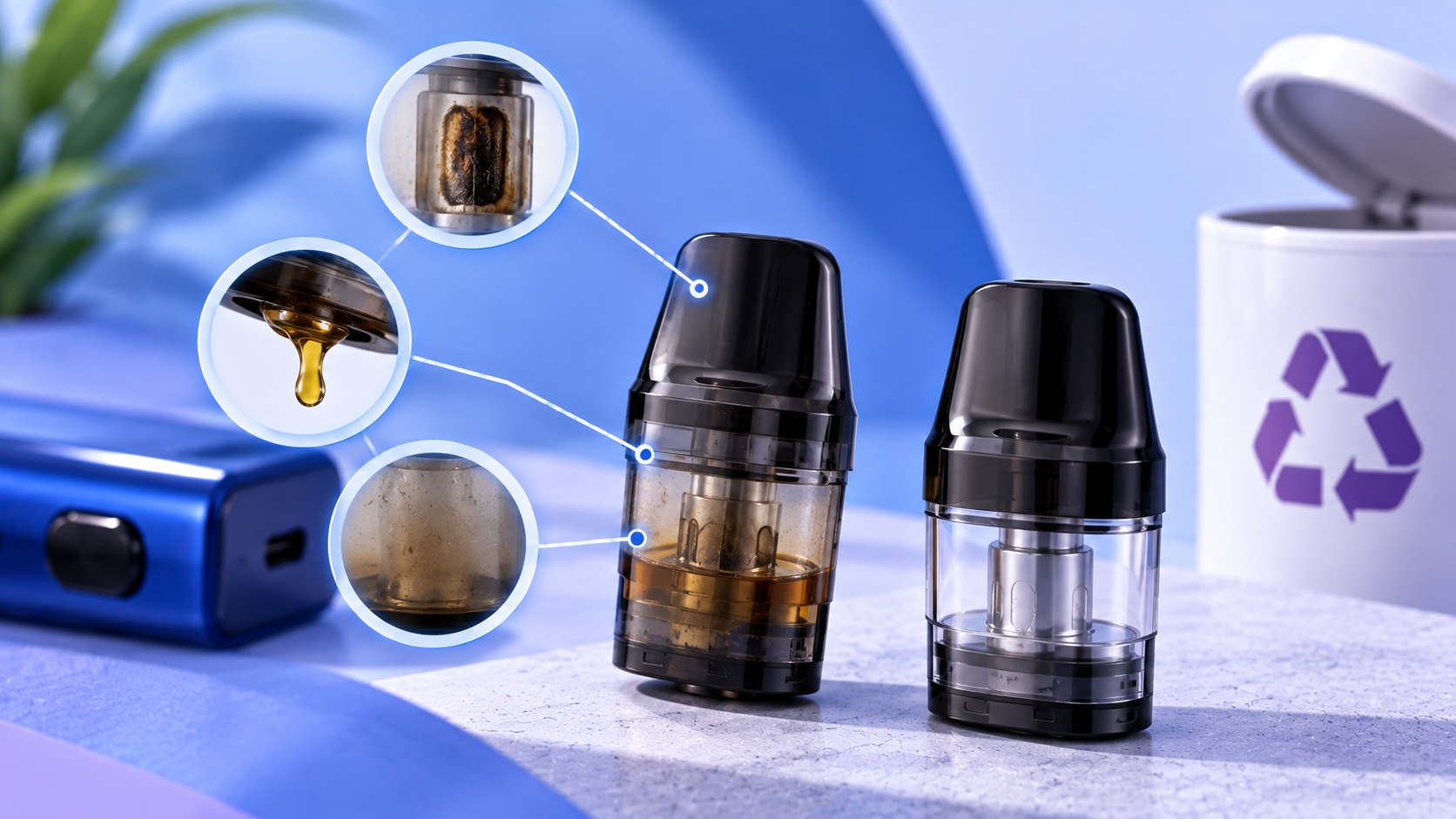
Vape pods don't always stop working all at once. A cartridge can gradually lose performance, develop a damaged seal, fit less securely, or—in the case of a built-in coil pod—reach the end of its usable coil life.
That can make it difficult to know whether you need a new pod, a new coil, or simply need to check the cartridge and connection.
The key is understanding what type of pod your device uses and looking at its actual condition instead of replacing it according to a universal number of days.
First, Know What Type of Vape Pod You Have
Before deciding whether a pod needs replacing, determine whether your device uses a built-in coil pod or a replaceable-coil pod.
Built-in coil pods contain the heating coil permanently inside the cartridge. When that coil reaches the end of its usable life, you normally replace the entire pod.
Replaceable-coil pods use a separate coil that can be removed from the cartridge. If the coil is worn but the pod remains undamaged and functional, you may only need the correct replacement coil.
Knowing which design you have prevents replacing an entire cartridge when only the coil needs attention—or buying a standalone coil for a pod that doesn't accept one.
1. The Pod Is Cracked or Physically Damaged
Visible physical damage is one of the clearest signs that a pod should be replaced.
Check the cartridge for:
- Cracks in the pod body
- Chipped or damaged edges
- Warping or deformation
- Damage around the mouthpiece
- Damage around the fill port or closure
Physical damage can affect how the cartridge seals, fits, or connects to the device. A visibly cracked or deformed pod should not be treated as a component that simply needs more cleaning or adjustment.
2. The Pod No Longer Fits Securely
Pods are designed to sit in their devices in a specific way. Depending on the system, the cartridge may be held in place by magnets, clips, friction, or another connection design.
If a pod that previously fit correctly becomes unusually loose, rocks excessively, repeatedly lifts out of position, or no longer stays seated, inspect the cartridge and device connection.
Check for visible damage and make sure accessible connection areas are clean according to the manufacturer's instructions. If the cartridge itself is worn or damaged and no longer fits as intended, replacement may be necessary.
3. The Pod Keeps Leaking From the Cartridge
Not every trace of liquid around a pod means the cartridge has failed. Condensation, filling technique, overfilling, or other factors can sometimes produce moisture around the pod.
Persistent leakage becomes more relevant to pod replacement when you can identify damage to the cartridge body, fill-port closure, seal, or another part of the pod itself.
If the cartridge is correctly filled and installed but continues leaking from a visibly damaged area, replacing the pod is generally more appropriate than continuing to use a compromised cartridge.
Because pod leaks can have several causes, leakage by itself shouldn't automatically be treated as proof that the cartridge has reached the end of its life.
4. A Built-In Coil Pod Has Lost Its Normal Performance
With a built-in coil pod, the coil and cartridge are replaced together. That means changes associated with an exhausted integrated coil can eventually indicate that the complete pod needs replacing.
Possible signs include:
- Persistent unpleasant or burnt taste
- Noticeably weaker flavor than normal
- Reduced vapor under otherwise normal conditions
- Performance that doesn't recover after the pod is properly filled and saturated
These changes are more useful than assuming every pod lasts a fixed number of days. Coil life can vary according to the coil design, e-liquid, power, usage frequency, and other operating conditions.
Vape.com's coil lifespan guide covers those factors in more detail. For a built-in coil cartridge, however, replacing an exhausted coil means replacing the complete pod.
5. The Fill Port or Seal Is Damaged
Refillable pods commonly use a plug, cap, or other closure to keep the fill opening sealed during normal use.
Inspect this area if the pod becomes difficult to close properly or begins leaking around the fill opening. A closure that is torn, stretched, missing, or permanently deformed may no longer seal the cartridge as intended.
If the damaged seal or closure is integrated into the cartridge and the manufacturer does not provide it as a separately replaceable component, replacing the pod may be the appropriate option.
6. The Pod's Electrical Contacts Are Damaged
Many pod systems use electrical contacts on the bottom of the cartridge to connect the coil to the device.
Moisture or residue around accessible contacts can sometimes interfere with that connection, so a temporary detection issue does not automatically mean the pod needs replacing.
However, contacts that are visibly damaged, heavily worn, corroded, or physically deformed may prevent the cartridge from making a reliable connection.
If your device displays an atomizer-detection warning, Vape.com's No Atomizer guide covers that issue separately rather than assuming the cartridge automatically needs replacement.
7. The Pod Has Become Consistently Unreliable
Sometimes a pod doesn't show one obvious failure. Instead, several small mechanical problems begin appearing together.
The cartridge may need frequent repositioning, the mouthpiece or fill closure may no longer feel secure, or the pod may repeatedly lose its normal fit despite being installed correctly.
If the problem can be traced to physical wear or damage to the replaceable cartridge itself, replacing the pod is usually more appropriate than repeatedly trying to compensate for the worn component.
Pod or Coil: Which One Actually Needs Replacing?
| Situation | What Usually Needs Attention |
|---|---|
| Built-in coil has reached the end of its usable life | Complete pod |
| Replaceable coil is worn but cartridge is undamaged | Compatible coil |
| Pod body is cracked or deformed | Complete pod |
| Integrated fill-port seal is damaged | Pod, according to manufacturer guidance |
| Pod contacts are physically damaged | Complete pod |
How Often Should You Replace a Vape Pod?
There isn't one replacement interval that applies to every pod system.
A built-in coil pod may need replacing when its integrated coil reaches the end of its usable life. A replaceable-coil cartridge can potentially remain in service longer because the coil is changed independently, provided the cartridge itself remains in suitable condition.
How quickly components wear can depend on the pod design, coil, e-liquid, power level, frequency of use, handling, and manufacturer specifications.
Condition and performance are therefore more useful indicators than a fixed replacement schedule.
Before Installing a Replacement Pod
Before installing a new cartridge, confirm that it is specifically designed for your exact device or product family. Similar-looking pods—even from the same brand—are not necessarily interchangeable.
Check:
- Exact device model
- Pod or cartridge series
- Manufacturer-listed device compatibility
- Built-in or replaceable-coil design
- Resistance option, when applicable
If you're uncertain about which cartridge or coil fits your setup, Vape.com's compatibility guide explains how to check device, pod, coil, and tank compatibility before choosing replacement hardware.
Bottom Line
You don't need to replace a vape pod simply because it has been used for a certain number of days. Start with the type of cartridge you have and its actual condition.
For a built-in coil pod, worn coil performance generally means replacing the complete cartridge. With a replaceable-coil pod, a worn coil may only require a new compatible coil if the cartridge itself remains functional.
Cracks, damaged seals, damaged contacts, persistent cartridge-related leakage, or a pod that no longer fits as intended are stronger signs that the cartridge itself may need replacement.
Pod construction, coil design, compatibility, and replacement procedures vary by manufacturer and model. Check the current manufacturer instructions for your exact device and replace visibly damaged cartridges rather than relying on a universal replacement interval.