 United States
What Is Pass-Through Charging on a Vape?
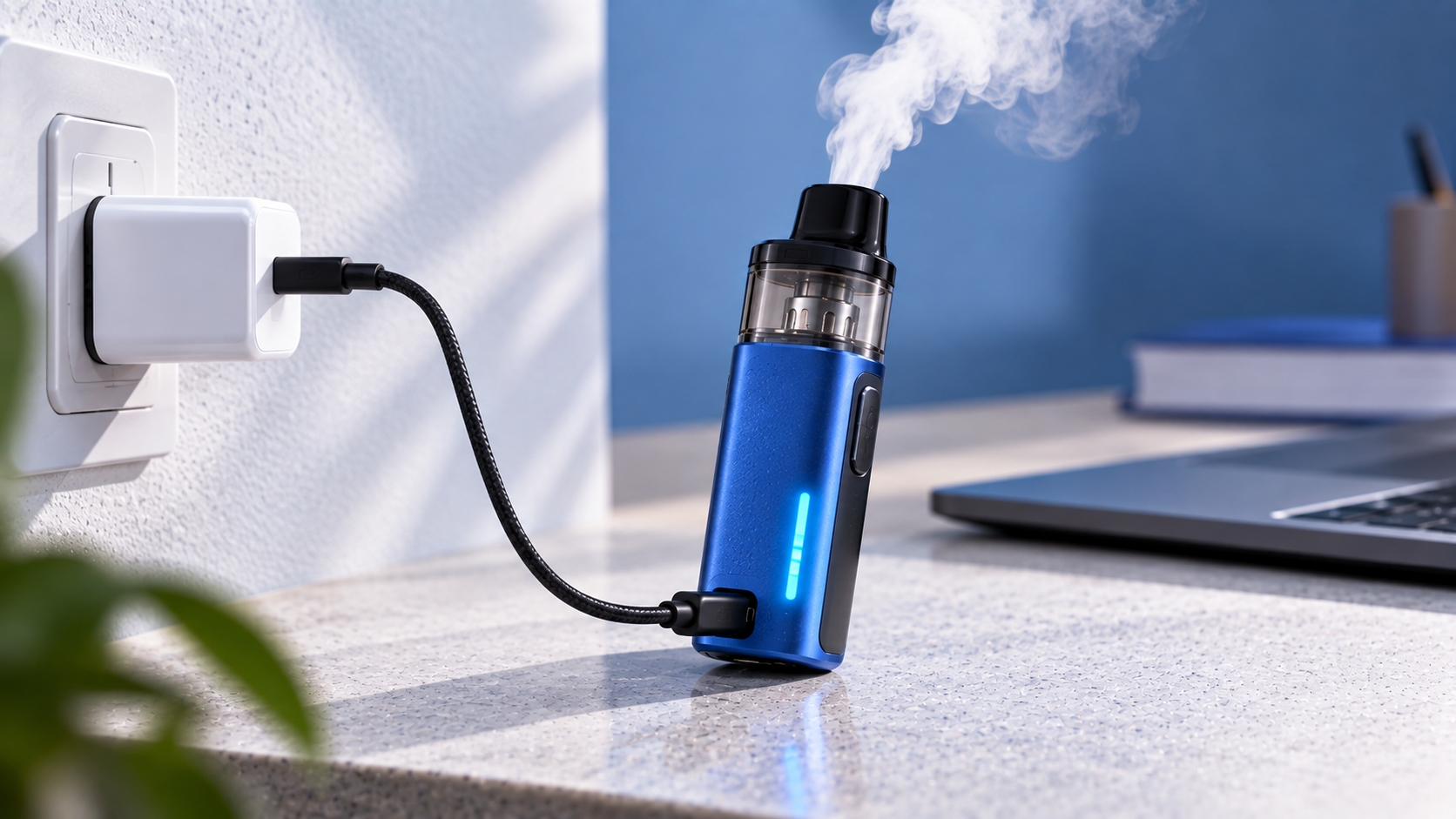
This guide is intended for adult users of legal purchasing age. Pass-through charging is manufacturer- and model-specific. Confirm whether your exact device supports operation while charging through its official manual or specifications, and follow the manufacturer's charging requirements rather than assuming all rechargeable devices behave the same way.
You plug your vape into a charger, notice that it still activates, and wonder whether that's normal. On some devices, it may be. Certain rechargeable vapes are designed with pass-through charging, allowing the device to operate while it is connected to an external power source.
But being rechargeable does not automatically mean a vape supports pass-through use. Some devices intentionally disable activation during charging, while others handle charging and operation differently depending on their internal electronics.
Understanding the distinction helps explain why one device may continue working when plugged in while another temporarily becomes unavailable until it is disconnected.
What Is Pass-Through Charging on a Vape?
Pass-through charging generally refers to a device design that allows the vape to be operated while it is connected to a charging power source.
In practical terms, this means a compatible device does not necessarily need to remain completely inactive throughout the charging session.
The exact electrical behavior behind this feature can vary. How charging, battery management, and device activation are handled depends on the manufacturer's circuitry and firmware, so pass-through support should be treated as a documented device feature rather than assumed from the presence of a USB port.
How Does Pass-Through Charging Work?
Rechargeable regulated devices contain electronics that manage charging and normal operation. On a model designed for pass-through use, those electronics allow activation under the conditions specified by the manufacturer while external power is connected.
The device chipset can be involved in functions such as power control, battery monitoring, activation, and programmed operating protections, although the exact charging architecture varies between products.
This is different from simply connecting a battery directly to a power source. Charging and device operation are managed by electronic systems designed for that particular hardware.
Does Pass-Through Mean the Vape Runs Directly From the Charger?
Not necessarily. The term is sometimes interpreted as meaning that power completely bypasses the battery and travels directly from the charger to the coil, but that should not be assumed for every device.
Charging architectures differ, and the way external power, battery charging, and activation interact is determined by the internal design. Without manufacturer documentation describing the electrical path, it is more accurate to say that a pass-through-capable device allows operation while connected to charging power.
This distinction matters because the name describes the user-facing capability, not a universal circuit design shared by every vape.
Do All Rechargeable Vapes Have Pass-Through Charging?
No. Rechargeability and pass-through operation are separate features.
Depending on its design, a rechargeable device may allow activation while connected, interrupt charging during activation, disable activation while plugged in, or use another manufacturer-specific charging behavior.
The correct behavior for a particular model should come from its manual or official specifications rather than from what another rechargeable device does.
How Can You Tell If a Vape Supports Pass-Through Charging?
The most reliable indicator is explicit manufacturer documentation stating that the device supports pass-through charging, pass-through use, or operation while charging.
Do not treat the presence of USB-C, micro-USB, fast charging, or an internal battery as proof. Those features describe the charging connection or battery system, not necessarily whether activation is permitted while power is connected.
Likewise, the fact that a device happens to activate while plugged in does not replace the manufacturer's instructions. The FDA's vape battery guidance recommends reading and understanding the manufacturer's recommendations for the use and care of the device.
What Happens on a Vape Without Pass-Through Charging?
A device without pass-through support may temporarily disable normal activation while connected to charging power.
Pressing the fire button or attempting to activate the device may produce no response, or the screen or LED may continue showing only charging information.
That behavior does not automatically mean the vape is malfunctioning. Preventing activation during charging may simply be part of the manufacturer's intended design.
Pass-Through Charging vs. Fast Charging
Pass-through charging and fast charging describe two different capabilities and should not be used interchangeably.
| Feature | What It Describes |
|---|---|
| Pass-Through Charging | Whether the device supports operation while connected to charging power |
| Fast Charging | How quickly a compatible charging system can replenish the battery under specified conditions |
| USB-C | A connector type; it does not by itself establish charging speed or pass-through support |
A device could support one feature without supporting the other. Charging performance depends on the complete charging system rather than the connector shape alone.
Pass-Through Charging vs. Charging Indicators
A light or screen appearing when a device is plugged in only confirms that the device is communicating some form of charging status. It does not necessarily indicate pass-through capability.
Depending on the model, LED indicators may change color, pulse, remain illuminated, or switch off at different stages of charging. Screen-equipped devices may instead display a battery icon or charging animation.
Those indicators should be interpreted according to the manual for the exact device, especially when determining whether activation during charging is normal.
Does Pass-Through Charging Make Charging Faster?
No. Pass-through support does not itself mean that the battery charges faster.
Charging speed can depend on factors such as the device's charging circuitry, supported input, battery design, cable, power source, battery level, and temperature-management behavior.
Pass-through describes whether operation is supported while charging; it does not specify how quickly the battery reaches a full charge.
Does Using a Vape While Charging Affect Charge Time?
On a device that officially supports pass-through use, operating it while connected may affect how charging progresses because the device is being used during the charging session.
The exact effect depends on how that particular device manages power and charging. Follow the manufacturer's expected charging behavior rather than assuming every pass-through device continues charging at the same rate during activation.
Is Pass-Through Charging the Same on Every Vape?
No. Manufacturers can implement the feature differently.
Differences may include when activation is permitted, whether charging pauses during use, which charging inputs are supported, how the device communicates charging status, and what conditions cause the electronics to restrict operation.
This is why the term “pass-through charging” should not be used to infer specifications that the manufacturer has not documented.
What About Pod Systems With Built-In Batteries?
Many compact pod systems use internal rechargeable batteries, but their behavior while plugged in varies by model.
Some may support activation while connected to power, while others intentionally remain unavailable until charging is finished or the cable is removed.
Because the battery is integrated into these devices, the manufacturer's specifications should be used to confirm the intended charging input, charging behavior, and whether pass-through operation is supported.
Does Pass-Through Charging Replace Good Battery Practices?
No. Pass-through support is an operating feature, not a substitute for proper charging and battery handling. The FDA's battery safety guidance recommends following the manufacturer's use and care instructions and charging a vape on a clean, flat surface where it can be clearly seen.
The U.S. Fire Administration has also documented fires and explosions involving electronic cigarettes and lithium-ion batteries and emphasizes following manufacturer charging instructions.
Suitable charging equipment, battery condition, storage, and handling therefore remain part of battery safety regardless of whether a device supports operation while plugged in.
When Should You Avoid Using a Vape While It's Charging?
Do not attempt to use the device while connected to power when the manufacturer does not explicitly support that behavior.
Battery condition also matters. The U.S. Fire Administration's battery safety guidance identifies warning signs such as excessive heat, changes in shape, leaking, unusual odor, or abnormal noises as reasons to stop using a lithium-ion battery.
Do not continue using or charging a device with obvious battery damage, a damaged charging connection, or another abnormal condition. Do not modify charging hardware or attempt to bypass a device that intentionally disables activation while charging.
How to Check Whether Your Device Has Pass-Through Charging
- Identify the exact model. Similar-looking devices or different generations can have different charging features.
- Check the official specifications. Look for explicit mention of pass-through charging or operation while charging.
- Review the charging instructions. Confirm the manufacturer's recommended charging equipment, input, and procedure.
- Check the operating instructions. Determine whether activation is intentionally enabled or disabled while plugged in.
- Follow the documented behavior. Do not attempt to override charging restrictions built into the device.
Common Pass-Through Charging Misunderstandings
| Assumption | More Accurate Explanation |
|---|---|
| Every rechargeable vape has pass-through | Pass-through is a separate device-specific feature |
| USB-C means pass-through is supported | USB-C identifies the connector, not the device's operating behavior |
| Pass-through means faster charging | Pass-through and charging speed describe different features |
| The device always runs directly from USB power | The internal power path depends on the specific charging architecture |
| If it activates while plugged in, it must support pass-through | Manufacturer documentation should confirm intended pass-through operation |
Bottom Line
Pass-through charging on a vape means that a device is designed to allow operation while it is connected to charging power. It does not automatically mean the device charges faster, runs directly from the charger, or behaves like every other pass-through-capable model.
Most importantly, rechargeability alone does not confirm pass-through support. USB-C ports, charging LEDs, internal batteries, and fast-charging features are separate characteristics.
Use the specifications for your exact model to determine whether operation while charging is an intended feature and follow the manufacturer's charging requirements whenever the device is connected to power.
Charging guidance should come from the manufacturer of your exact device. FDA and U.S. Fire Administration safety guidance also emphasize following manufacturer instructions when charging vape devices and lithium-ion batteries.