 United States
Ohm's Law for Vapers: A No-Math Guide to Sub-Ohm Safety
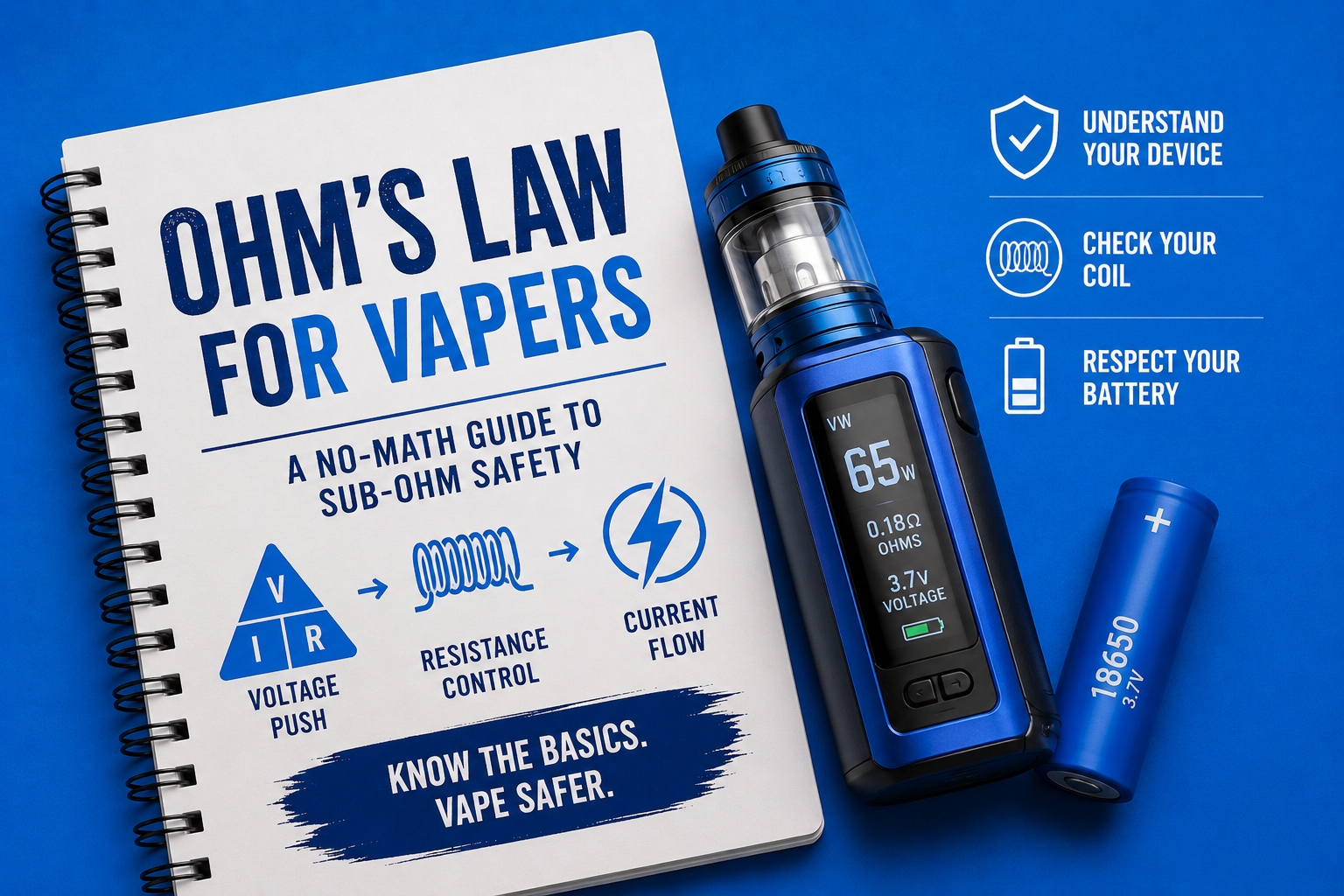
This guide provides general electrical and battery-safety information. Safe operating limits depend on the specific device, battery, coil, and configuration. Always follow the specifications provided by the manufacturers of your hardware and batteries.
Ohm's Law can sound more complicated than it needs to be. For most people using manufacturer-specified coils in a regulated vape device, there is no need to calculate every electrical value manually. What matters is understanding what resistance, voltage, current, and power represent—and knowing when battery limits become important.
The electrical relationships matter most when working with removable batteries, rebuildable atomizers, very low-resistance builds, or unregulated/mechanical devices where the user has greater responsibility for verifying that the complete setup operates within safe limits.
What Ohm's Law Actually Means
Ohm's Law describes the relationship between voltage, current, and resistance. Power, measured in watts, is closely related to those values and describes the rate at which electrical energy is being delivered.
- Resistance (Ω): Electrical resistance, measured in ohms.
- Voltage (V): Electrical potential difference, measured in volts.
- Current (A): Electrical current, measured in amperes or amps.
- Power (W): Electrical power, measured in watts.
These values are related rather than independent. That is why a coil's resistance should not be interpreted by itself when deciding whether a particular setup is compatible or operating appropriately.
On devices with screens, these electrical values may appear together. Understanding watts, ohms, and volts can help distinguish a measured coil resistance from an adjustable power setting or a voltage value calculated by the device.
What Does Sub-Ohm Mean?
In vaping terminology, sub-ohm generally refers to a coil or build with resistance below 1.0Ω. That definition describes resistance; it does not establish a universal wattage, battery requirement, vapor output, or safety threshold by itself.
Lower-resistance coils are commonly used in higher-output setups, but actual operating power depends on the device and coil specifications. A 0.2Ω coil from one product family may have a very different recommended wattage range from another 0.2Ω coil because coil geometry, material, wick design, airflow, and other factors differ.
That is why coil resistance and performance should be considered together with compatibility and manufacturer specifications rather than using resistance alone to select a power level.
Why the Device Type Changes the Safety Picture
Regulated Devices
A regulated vape device uses electronic circuitry to control its output and may include protections for conditions such as low resistance, short circuits, excessive current, low battery voltage, or excessive operating time. The exact protections and thresholds vary by device.
Those protections are useful, but they are not a reason to ignore manufacturer specifications. Use compatible coils and batteries and operate the device within its documented limits.
Mechanical or Unregulated Devices
Mechanical and other unregulated setups do not manage output in the same way as regulated mods. Battery voltage, coil resistance, connections, and battery capability therefore require much more direct attention from the user.
If you cannot independently verify coil resistance, battery specifications, current demand, and the condition of the complete electrical path, a mechanical setup is not an appropriate place to experiment.
Battery Limits Still Matter
Removable lithium-ion cells have electrical and physical limits. A battery that physically fits inside a device is not automatically suitable for that device or configuration.
Use the battery type and specifications required by the device manufacturer. Existing vape battery safety guidance also covers battery condition, charging, storage, multi-battery setups, and the risks of using damaged cells.
The U.S. Food and Drug Administration advises users to use batteries recommended for their specific vaping device, keep loose batteries away from metal objects such as keys and coins, and replace batteries if they become damaged or wet.
For removable-cell devices, do not substitute an unknown battery simply because it has the same physical dimensions. Battery specifications, authenticity, condition, and the device manufacturer's requirements all matter.
Wattage: Follow the Coil's Specified Range
On a variable-wattage regulated device, wattage is often the main output setting the user controls. Instead of assigning a universal wattage to a resistance value, use the operating range specified for the exact coil and device.
For example, two coils can share the same nominal resistance while using different materials, mesh structures, surface areas, and wicks. Their appropriate operating ranges may therefore differ substantially.
When a manufacturer provides a recommended wattage range, stay within that range. If the instructions recommend beginning toward the lower end before increasing power, follow that procedure rather than applying a generic wattage chart.
Why a Universal Resistance-to-Wattage Chart Can Be Misleading
A table that says every 0.5Ω coil should operate at one wattage range—or that every coil below a certain resistance requires one particular battery rating—oversimplifies the electrical and hardware variables involved.
Resistance is only one specification. Coil construction, device output, battery configuration, electrical protections, airflow, and manufacturer limits also affect how the setup operates.
| Specification | What It Tells You | What It Does Not Tell You Alone |
|---|---|---|
| Resistance (Ω) | Electrical resistance of the coil/build | A universal safe wattage or battery |
| Wattage (W) | Electrical power delivered | Whether a specific coil is compatible |
| Battery rating | Part of the cell's operating specifications | Whether the cell is appropriate for every device |
| Recommended coil range | Manufacturer-specified operating range for that coil | A universal range for all coils with the same resistance |
Five Practical Electrical and Battery Safety Habits
- Use the specified battery. If your device uses removable cells, follow the device manufacturer's battery requirements rather than choosing a cell based only on size.
- Inspect removable batteries. Stop using a battery that is dented, leaking, swollen, unusually hot, or has damaged wrapping or insulation.
- Protect loose batteries from metal objects. Do not carry unprotected removable cells with keys, coins, or other conductive objects that could contact the terminals.
- Use compatible coils within their specified operating range. Do not assume that two coils with the same resistance have identical power requirements.
- Do not ignore abnormal device behavior. Unexpected heat, repeated electrical warnings, inconsistent resistance readings, damaged connections, or other abnormal behavior should be investigated rather than bypassing device protections.
What About Coil Priming?
Priming a new replaceable coil is primarily about saturating its wick before normal operation; it should not be described as a method of reducing battery current or electrical stress.
Follow the preparation instructions for the exact coil. Proper coil priming can help avoid activating a dry wick, while electrical safety remains a separate matter involving device compatibility, resistance, output, and battery limits.
The Takeaway
You do not need to memorize an electrical engineering textbook to use a manufacturer-specified coil in a regulated device, but Ohm's Law should not be reduced to “lower resistance always means more battery strain” without considering voltage, power, device regulation, and the complete circuit.
For regulated setups, use compatible coils, stay within manufacturer-specified operating ranges, and use the batteries required for the device. Rebuildable and mechanical setups require additional electrical knowledge because the user has greater responsibility for verifying resistance, current demand, battery capability, and hardware condition.
Sources & Further Reading
- U.S. Food & Drug Administration — Tips to Help Avoid Vape Battery Fires or Explosions
- U.S. Food & Drug Administration — E-Cigarettes, Vapes, and Other Electronic Nicotine Delivery Systems
Electrical limits vary by device, coil, and battery. Follow the specifications supplied by the manufacturers of all components. Stop using damaged batteries or hardware, and do not bypass device protection warnings.