 United States

What Affects Vape E-Liquid Consumption? Wattage, Coils & Airflow
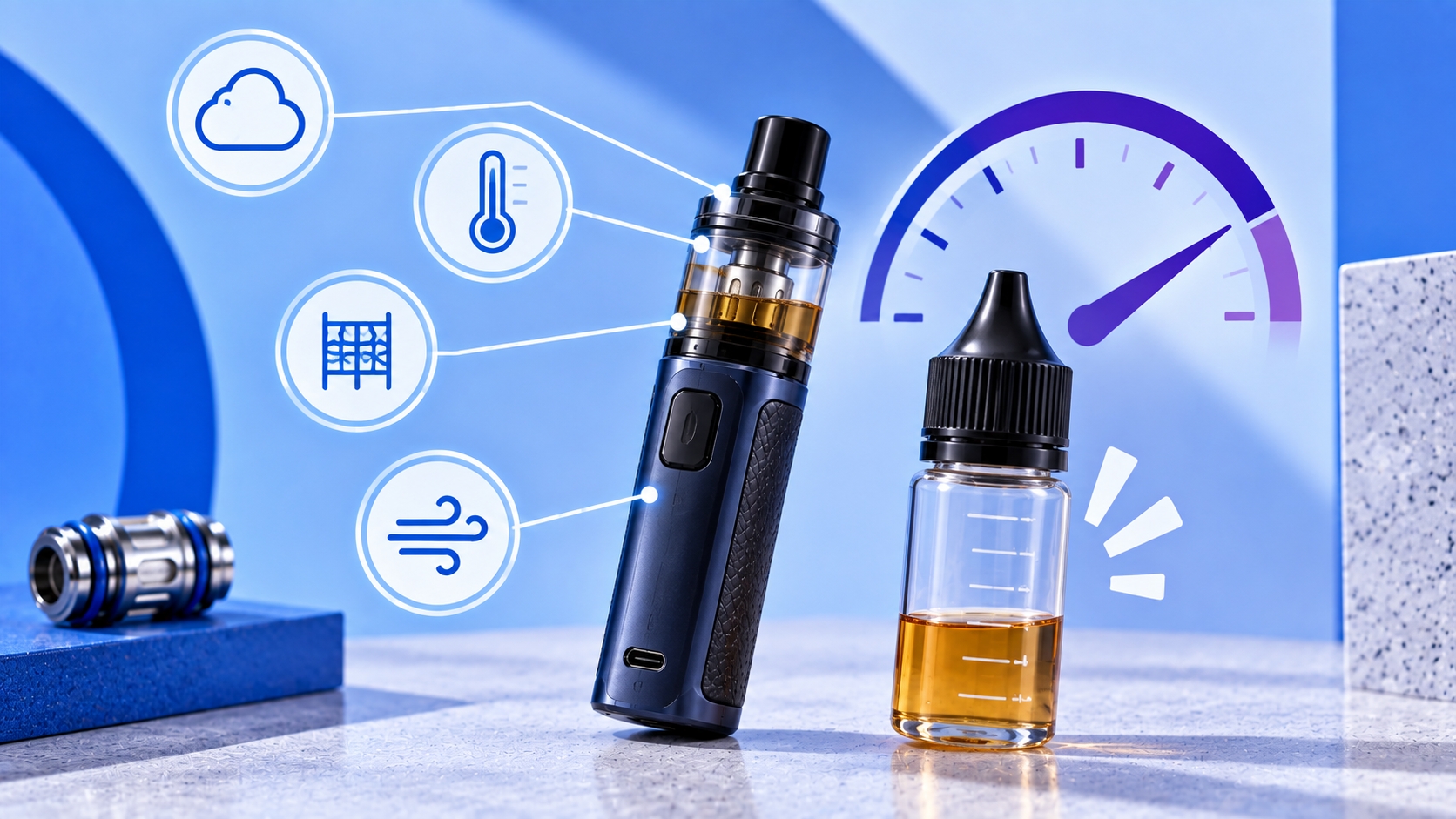
Note: E-liquid consumption varies by device, coil, operating power, liquid characteristics, and usage pattern. No universal consumption rate applies to every setup. Follow the manufacturer's specifications for your exact hardware.
Why do some vape devices use more e-liquid than others, even when their tanks have similar capacities? The answer involves how the heating system converts liquid into aerosol and how the device is operated.
Wattage, coil construction, airflow, draw duration, and e-liquid properties can all affect consumption. These factors interact, so no single specification can reliably predict how long a refill will last.
This guide explains the technical factors that influence vape e-liquid consumption, why different setups produce different results, and how to interpret the specifications of a device.
What Determines Vape E-Liquid Consumption?
E-liquid consumption describes the amount of liquid used by a device over a period of operation or across a series of puffs.
In laboratory research, consumption may be measured as liquid mass lost from a reservoir or as the amount of liquid converted into aerosol under specified testing conditions.
The most important variables include supplied electrical power, atomizer characteristics, heating duration, usage frequency, and the liquid's physical properties.
Because these variables interact, comparing devices requires more context than their tank capacities or advertised coil resistance.
1. How Wattage Affects E-Liquid Consumption
Wattage measures the rate at which electrical energy is supplied to the heating element.
When the same compatible atomizer operates at a higher power within its supported range, it may vaporize more liquid during a comparable draw.
Experimental research on atomizer performance has found that supplied power influences the amount of e-liquid vaporized. However, the relationship depends on the coil and device configuration rather than wattage alone.
For devices with adjustable settings, the selected wattage may be visible alongside resistance and voltage information. Understanding the wattage display helps distinguish these different measurements.
Power should always remain within the manufacturer's recommended operating range for the installed coil.
2. How Coil Resistance Relates to Consumption
Coil resistance is measured in ohms (Ω) and describes the electrical resistance of the heating element.
Resistance is important, but it does not independently determine how much e-liquid a device uses.
For example, two coils with different resistance values may also have different recommended wattages, heating surfaces, materials, and wicking arrangements.
Controlled research comparing lower-resistance/higher-power and higher-resistance/lower-power configurations has reported differences in liquid consumption under the tested conditions.
Those findings should not be interpreted as proof that every low-resistance coil always consumes a fixed amount of additional liquid.
3. Why Coil Construction and Surface Area Matter
Coils with similar resistance values can behave differently because their heating elements are constructed differently.
Design characteristics may include wire or mesh construction, heating surface area, material, wick arrangement, and the coil's intended operating range.
These characteristics influence heat transfer and liquid delivery to the heating surface. Their combined effect helps determine how a coil performs under a particular power setting.
Different replacement coils may therefore produce different consumption patterns, even when installed in compatible devices.
The correct comparison is between complete coil specifications and supported operating conditions, not resistance alone.
4. How Airflow Influences E-Liquid Consumption
Airflow affects the movement of air through the atomizer and influences cooling, aerosol transport, and draw characteristics.
However, airflow should not be treated as a simple independent control for liquid consumption.
A device with more open airflow may also be designed for higher power and different coil construction. Users may take different types of draws with that setup.
As a result, consumption differences between open-airflow and restricted-airflow systems may reflect several design and usage factors operating together.
Adjust airflow only within the manufacturer's intended operating conditions rather than assuming that a tighter or more open setting will always reduce consumption.
5. Puff Duration and Frequency
Electrical power describes energy delivery per unit of time, but the total time a coil is activated also matters.
Longer activation periods can increase the energy delivered during a draw, while more frequent draws increase the number of heating cycles over a session.
Research on electronic-cigarette puffing regimes found that puff duration and intervals between puffs were important variables affecting aerosol yield under the tested conditions.
A device's puff counter can indicate how often it has been activated, but it cannot independently measure the exact volume of liquid consumed. Two puffs of different durations may use different amounts of liquid.
6. How Tank and Pod Design Affect Consumption
Different tanks and pod systems combine distinct coil platforms, power ranges, airflow arrangements, and liquid-delivery designs.
A compact lower-output pod system may operate differently from a higher-powered tank even when both contain the same amount of liquid.
Reservoir capacity indicates how much liquid a tank or pod can hold. It does not directly measure the rate at which that liquid is consumed.
The design of vape tanks can therefore influence how long a fill lasts, but capacity should be evaluated alongside the coil, operating conditions, and usage pattern.
7. The Role of E-Liquid Composition
E-liquids differ in physical properties, including viscosity, because of variations in vegetable glycerin (VG), propylene glycol (PG), and other ingredients.
These properties can influence how liquid moves through a wick and interacts with the heating element.
However, it is not scientifically justified to claim that one VG/PG ratio always results in lower consumption across every device.
Different hardware may have different liquid compatibility requirements. The relationship between liquid composition and device operation is explored in Vape.com's VG/PG ratio article.
How the Main Factors Compare
| Factor | What It Changes | Important Limitation |
|---|---|---|
| Wattage | Electrical power supplied to the coil | Effects depend on the atomizer and operating range |
| Coil resistance | Electrical characteristics of the heating element | Resistance alone cannot predict consumption |
| Coil construction | Heating surface and liquid delivery | Designs cannot be compared by one specification |
| Airflow | Cooling, draw characteristics, aerosol transport | Interacts with power, hardware, and usage |
| Puff duration | Time the coil remains active | Different durations can produce different yields |
| E-liquid composition | Physical properties and wicking behavior | No universal VG/PG consumption rule |
Can You Predict How Long a Tank of E-Liquid Will Last?
Not accurately from tank capacity alone.
A larger reservoir may hold more liquid, but the actual duration of a fill depends on the device's operating conditions and how frequently it is used.
Laboratory measurements can compare specific devices under controlled puffing conditions. Those results should not automatically be applied to different hardware or real-world usage patterns.
For meaningful comparisons, consider the complete setup and the conditions under which consumption was measured.
E-Liquid Consumption vs. E-Liquid Leakage
Consumption and leakage are not the same thing.
During normal operation, liquid is transported to the heating element and contributes to aerosol generation. With leakage, liquid escapes from the intended reservoir or airflow system.
A reservoir that loses liquid while the device is unused, or liquid accumulating around the housing, may indicate a leak rather than normal consumption.
Vape.com's tank leaking article addresses those symptoms in more detail.
Why Technical Specifications Matter More Than a Single Consumption Estimate
A device's wattage, coil resistance, tank capacity, and airflow specifications describe different aspects of its operation.
None of these measurements independently establishes how many milliliters of liquid will be used per day.
Understanding the interaction between hardware, settings, and activation patterns is more reliable than relying on a universal consumption figure.
Final Thoughts
Vape e-liquid consumption depends on several interacting technical factors, including electrical power, coil design, airflow, liquid properties, and how long or frequently the device operates.
Higher wattage or a different coil may change consumption, but neither specification tells the whole story. The most meaningful comparisons consider the complete hardware configuration and operating conditions.
Sources & Further Reading
- PubMed Central — Influence of Coil Power Ranges on E-Liquid Consumption
- PubMed Central — Effects of Coil Resistance and Nicotine Concentration
- PubMed — Influence of Puffing Regimes on Vaporized Liquid
Safety reminder: Technical comparisons do not replace manufacturer instructions. Use compatible components, remain within specified operating limits, and stop using visibly damaged or abnormally behaving hardware.